
What Is Recruitment: How Recruiting Agents Work in Blue-Collar Hiring — And What Fair Recruitment Looks Like

What Is Recruitment
Understanding what is recruitment, how agents work, and what separates ethical hiring from exploitation is essential knowledge for every skilled worker, every employer, and every agent operating in this space.
BlueCollarJobs.ai was built on a simple belief: the person looking for a job should never pay to find one. That belief sits at the heart of what fair recruitment actually means — and it is a standard that the blue-collar hiring industry in India has been consistently failing to meet.
What Is Recruitment? A Clear Definition
Recruitment is the structured process of identifying, attracting, evaluating, and placing the right person into the right job.
In the blue-collar sector, recruitment involves:
Matching a worker's certified trade skill to an employer's vacancy
Verifying credentials, location, and availability
Presenting a clear, honest job offer with accurate salary and conditions
Supporting the worker through the process without creating financial dependency
Done correctly, recruitment is a service that benefits both sides — the employer finds qualified workers, and the worker gains access to legitimate opportunities.
Done incorrectly, recruitment becomes a mechanism for extracting money from the people who can least afford it.
How Recruiting Agents Work — The Good and the Bad
A recruiting agent sits between a worker and an employer. In theory, they add value by sourcing candidates, verifying skills, and coordinating the placement. In practice, the blue-collar recruitment space in India is heavily populated by unlicensed agents who charge workers illegal fees, misrepresent job conditions, and take cuts from both sides.

India's blue-collar workforce numbers over 300 million people (Salarybox, 2026). Over 500,000 blue-collar workers are placed monthly across sectors — yet unlicensed recruiters routinely charge workers ₹20,000 to ₹1,50,000 in illegal placement fees. Workers arrive in jobs carrying debt they were never told they would incur.
The ILO's General Principles and Operational Guidelines for Fair Recruitment are unambiguous: workers should never pay recruitment fees, directly or indirectly, at any stage. The cost of recruitment belongs with the employer.
India's government is now codifying this. The draft Private Placement Agency (Regulation) Bill, 2025 — released for public consultation by the Ministry of Labour and Employment — is built around barring recruitment agencies from charging workers and requiring all agencies to hold a valid Registration Certificate (RC) issued by the Ministry of External Affairs (MEA).
Ethical vs Unethical Recruitment: A Direct Comparison
Factor | Unethical Recruitment | Ethical Recruitment |
|---|---|---|
Who pays the fee | The worker - often ₹20,000–₹1,50,000 | The employer - worker pays nothing |
Job offer transparency | Vague or verbal — conditions change on arrival | Written, clear, with verified salary and role details |
Agent registration | Unlicensed, unverified | Holds valid MEA Registration Certificate |
Employer verification | Unconfirmed - worker takes the agent's word | Employer screened and verified before placement |
Worker recourse | None - agent disappears after payment | Formal grievance process; transparent contact available |
International placement | Passport confiscation, contract substitution common | Legal contracts, FRRO compliance, ECR clearance confirmed |
ILO compliance | No | Yes - aligns with ILO Fair Recruitment Principles |
What Fair Recruitment Actually Looks Like
Fair recruitment in the blue-collar sector has four non-negotiable characteristics:
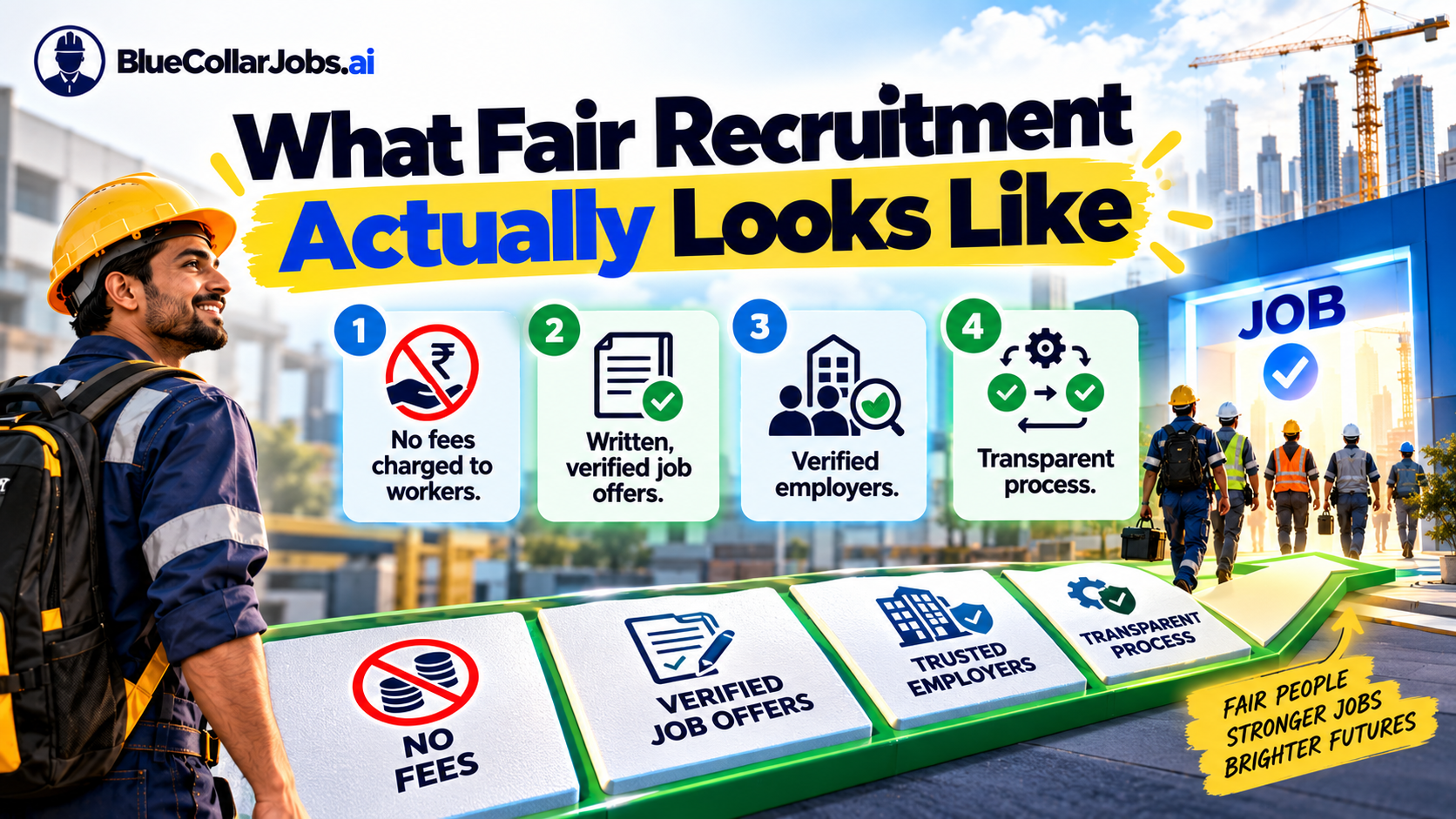
1. No fees charged to workers. Ever. Under any description — registration, processing, visa facilitation, training deposit. If a worker is being asked to pay, the process is not fair.
2. Written, verified job offers. The salary, job title, location, working hours, and contract duration must be documented before the worker commits. Verbal assurances are not recruitment. They are a risk.
3. Verified employers. The company offering the job must be real, registered, and confirmed as actively hiring. An agent who cannot provide verifiable employer details is not operating ethically.
4. Transparent process. The worker should know exactly where they are in the placement process at all times — what has been submitted, what is pending, and what happens next.
How BlueCollarJobs.ai is Building Fair Recruitment into its Model
BlueCollarJobs.ai is a direct-connection platform that removes the middleman from blue-collar recruitment entirely.
Workers register for ₹1,000 (Indian) or $20 (international) — a platform access fee, not a placement fee. They are never charged for being considered for a role, for making contact with an employer, or for being placed. Every employer listed on the platform is verified. Every job listing carries accurate salary and role information. The entire recruitment process is visible to the worker at every stage.
This is what recruitment is supposed to look like. Not a layer of agents extracting money from people who simply want to work — but a transparent, direct, fair pathway from skill to job.
Visit bluecollarjobs.ai — Register today and experience what fair recruitment actually means.
Frequently Asked Questions
1. What is recruitment in simple terms?
Recruitment is the process of finding and placing the right person into the right job. It involves matching skills to vacancies, verifying credentials, and connecting workers with employers through a clear, honest process. In the blue-collar sector, ethical recruitment means the employer pays the cost — never the worker.
2. Is it legal for a recruiting agent to charge workers a fee in India?
Charging workers placement fees goes against the ILO's Fair Recruitment Principles and India's draft Private Placement Agency (Regulation) Bill, 2025, which is specifically built around barring agencies from billing workers. All legitimate Indian recruitment agencies must hold a valid Registration Certificate (RC) from the Ministry of External Affairs. If an agent asks a worker to pay a fee, that is a serious red flag.
3. What is the difference between fair and unfair recruitment?
Fair recruitment charges nothing to the worker, provides a verified and written job offer, and works with screened employers. Unfair recruitment extracts fees from workers, offers vague or verbal conditions that change on arrival, and operates through unlicensed agents with no accountability. The ILO's General Principles for Fair Recruitment require that all costs sit with the employer, not the worker.
4. How does BlueCollarJobs.ai support ethical recruitment?
BlueCollarJobs.ai connects skilled workers directly with verified employers — no agents, no placement fees, no hidden charges. Workers pay a one-time platform registration fee (₹1,000 for Indian workers, $20 for international workers) to access verified job opportunities in India, the Gulf, Germany, Australia, and beyond. The entire recruitment process is transparent, from the placement application.
Sources:
ePeople India — Asked to Pay a Placement Fee? It's Mostly Illegal in India (2026)
ILO — General Principles and Operational Guidelines for Fair Recruitment
Global Workforce HR — 10 Costly Mistakes When Hiring Blue-Collar Talent from India
SalaryBox — How to Recruit Blue-Collar Workers Effectively in India (2026)
9CV9 Blog — How Much Do Recruitment Agencies Charge in India in 2026?
The Peoples Board — Hiring in India 2026: A Complete Guide for HR Leaders
Ministry of Labour and Employment — Draft Private Placement Agency (Regulation) Bill, 2025