
From Factory Floors to the AI Economy: A Short History of Blue Collar Jobs
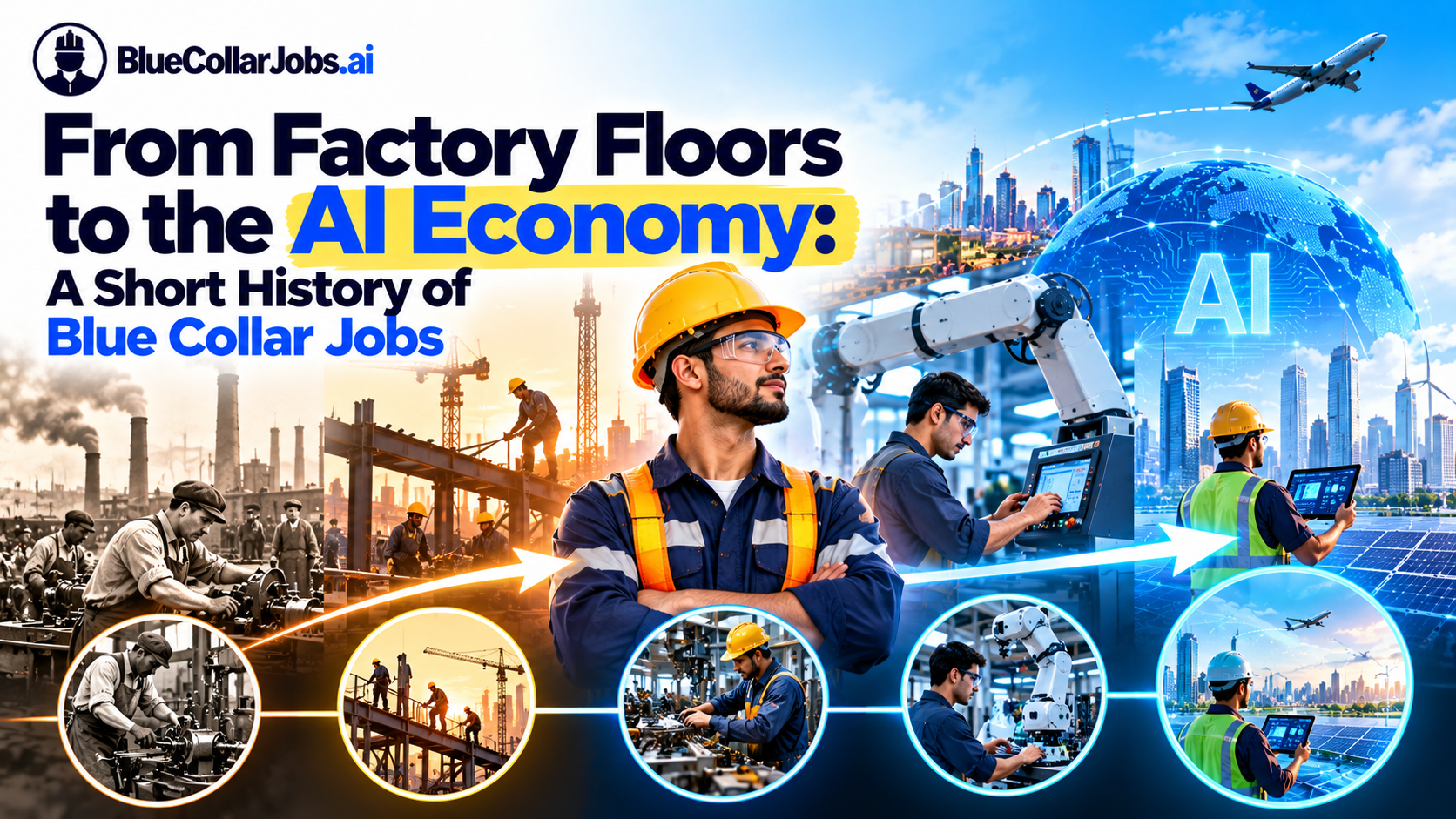
History of Blue Collar Jobs
The story of the blue collar job is really the story of every economy ever built. Before software companies, before office towers, before MBA programmes — there were people who built things, repaired things, and kept everything running with their hands and their skills. Understanding the is not an exercise in nostalgia. In 2026, it is the key to understanding why the AI economy is turning the job market upside down — and why the trades are coming out on top.
Platforms like BlueCollarJobs.ai exist precisely at this turning point, connecting skilled workers to the global employers who need them most right now.
A Short History of the Blue Collar Job — From Craft to Factory to Code
Every era has been shaped by what it needed people to do. The history of blue collar jobs follows that logic precisely.
Era | What Changed | Impact on Blue Collar Jobs |
|---|---|---|
Pre-Industrial (before 1760) | Craft-based economy — blacksmiths, carpenters, masons, weavers | Skilled tradespeople were the economy's backbone; every community depended on them |
Industrial Revolution (1760–1840) | Steam power, factories, assembly lines | Workers moved from farms and workshops to factories; the modern blue collar job was born |
Early 20th Century (1900–1950) | Mass manufacturing, Ford assembly line (1913), electrification | Manufacturing reached 35% of the US workforce; blue collar jobs drove the middle class |
Post-War Era (1950–1975) | Union strength, rising wages, global demand for goods | Peak blue-collar prosperity — trades jobs paid as well as office work |
Deindustrialisation (1980–2005) | Globalisation, offshoring, early automation | Manufacturing fell from 35% to under 10% of US jobs; blue collar job prestige declined |
Knowledge Economy (2005–2020) | Tech boom, startup culture, four-year degrees as default | White-collar became the aspired path; trades treated as secondary choices |
AI Economy (2020–present) | AI automates cognitive tasks; physical trades protected | White-collar jobs face disruption; blue collar jobs are resurging in demand and salary |
The Reversal Nobody Expected
For over a century, the story of the history of blue collar jobs was one of technology pushing workers off the factory floor. Machines replaced hands. Automation replaced repetition. The industrial worker seemed to be losing ground to the knowledge worker.
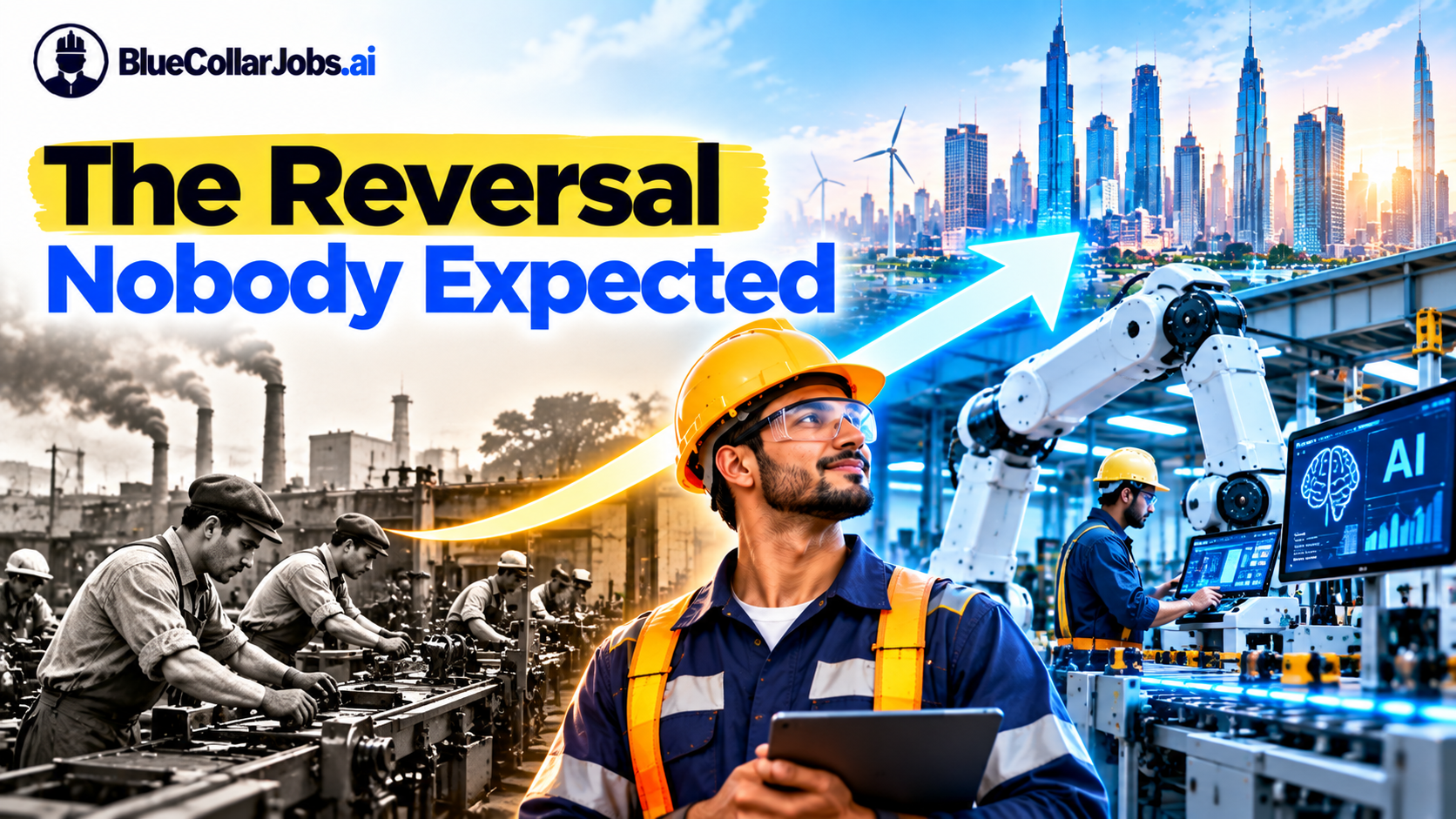
Then something unexpected happened.
Researchers at the Kellogg School of Management analysed nearly 200 years of data on technological change and employment. Their 2025 findings confirmed that, from the mid-19th century onwards, technology consistently reduced demand for manual labour — favouring white-collar cognitive work. But as AI specifically enters the picture, the pattern reverses. AI targets cognitive, routine office tasks — copywriting, data analysis, entry-level coding and financial processing. It largely cannot replicate what a tradesperson does on a job site.
Stanford's Digital Economy Lab found that early-career workers most exposed to AI — software developers, marketing professionals, and sales managers — experienced 16% slower employment growth between mid-2024 and September 2025. White-collar unemployment has risen each year since 2023. Blue-collar unemployment in construction and maintenance — largely declined over the same period.
Nvidia CEO Jensen Huang put it plainly at the World Economic Forum in January 2026: "This is the largest infrastructure buildout in human history — and it is going to create a lot of jobs." The AI data centres being built right now need electricians, HVAC technicians, structural workers, and industrial mechanics. The AI economy cannot run without the blue collar job.
In the words of the Kellogg researchers, "AI technologies really laser in on white-collar, cognitive-focused jobs. That's an essential difference between AI and earlier technologies."
Where the Blue Collar Job Stands in the AI Economy
The data in 2026 is unambiguous. <cite index="2-1"> 35% of the top-growing jobs are blue-collar roles, with over 1.7 million new positions projected by 2032. <cite index="7-1"> 73% of blue-collar workers already see AI as a positive force in their industry, and workers who receive AI-related training are over 50% more likely to be engaged and productive. Only 1% of blue-collar jobs face immediate automation risk.
The history of blue collar jobs shows a consistent pattern: every major technological shift created fear and short-term disruption, and then, for workers who adapted, better opportunities. The AI economy is following the same arc. The difference this time is that the workers doing the building, wiring, and maintenance are the ones the new economy cannot function without.
How BlueCollarJobs.ai Is Part of This Story
At every turning point in the history of blue collar jobs, the challenge was the same: skilled workers with genuine demand for their skills, separated from the employers who needed them by distance, information, and trust.

History of the Blue Collar Job
BlueCollarJobs.ai closes that gap directly. The platform connects certified tradespeople — electricians, welders, HVAC technicians, CNC operators, construction workers, and more — with verified employers across India, Gulf countries, Germany, Australia, and beyond. In the AI economy, where the demand for skilled physical work is rising while white-collar hiring slows, this connection has never been more valuable.
No fake agents. No misleading listings. No hidden fees. Just direct access to verified blue collar jobs with real employers who are actively hiring.
Indian workers — Register for just ₹1,000
International workers — Join for just $20
The blue collar job built every economy that came before this one. It is building the AI economy too.
Visit bluecollarjobs.ai — Register today and be part of what comes next.
Frequently Asked Questions
1. What is the history of blue collar jobs?
The history of blue collar jobs traces from pre-industrial craftsmen through the factory workers of the Industrial Revolution, the unionised manufacturing workforce of the 20th century, the deindustrialisation period of the 1980s–2000s, and into the current AI economy — where skilled trades are resurging in demand as AI targets white-collar cognitive work instead. The term "blue collar" itself was first popularised in the 1920s to describe workers who wore durable blue work shirts on the factory floor.
2. How is AI affecting blue collar jobs differently from white-collar jobs?
Kellogg School research (2025) analysed 200 years of technological change and found that AI specifically targets cognitive, routine, screen-based tasks — the core of white-collar work. Physical, adaptive, hands-on blue collar jobs are largely protected because no AI can yet reliably replicate the judgment, dexterity, and real-world problem-solving that trades work requires. Only 1% of blue collar jobs face immediate automation risk.
3. Are blue collar jobs growing in the AI economy?
Yes. <cite index="2-1">35% of the top-growing job categories are blue-collar roles, with over 1.7 million new positions projected by 2032. The AI economy is driving unprecedented demand for electricians, HVAC technicians, construction workers, and data centre maintenance professionals to build and maintain the physical infrastructure that AI runs on. Nvidia CEO Jensen Huang described it as "the largest infrastructure buildout in human history."
4. What does the history of blue collar jobs tell us about the future?
The consistent lesson from the history of blue collar jobs is that technology disrupts, but skilled adaptable workers find their place in what comes next. The Industrial Revolution ended farm work — and created factory jobs. Automation reduced repetitive manufacturing — and created technical trade roles. The AI economy is reducing white-collar cognitive work — and elevating the demand for physical, skilled, hands-on expertise that machines still cannot replicate.
5. How does BlueCollarJobs.ai connect workers to blue collar job opportunities in the AI economy?
BlueCollarJobs.ai is India's dedicated hiring platform for blue-collar and skilled trade workers, connecting them directly to verified employers across the Gulf, Germany, Australia, Canada, and domestically. In the AI economy, where demand for skilled blue collar jobs is rising globally, the platform provides a transparent, middleman-free pathway from a worker's certification to a verified international or domestic placement. Indian workers register for ₹1,000; international workers for $20.
Sources:
Kellogg School of Management — Is AI Turning Back the Clock on the Job Market? (February 2026)
Forbes — Blue Collar Is the New Growth Engine (November 2025)
ResumeCoach — Blue-Collar Job Statistics for 2026 (July 2026)
The Advantage Journal — The Blue-Collar Boom Nobody Saw Coming (March 2026)
Spectra360 — The Future of Blue-Collar Jobs: Technology and the Skilled Worker (2026)
ECM Tutors — The Changing Tides: From Blue Collar to White Collar