
Skills-Based Hiring: Why Resumes Don't Work for the Trades (2026 Guide)
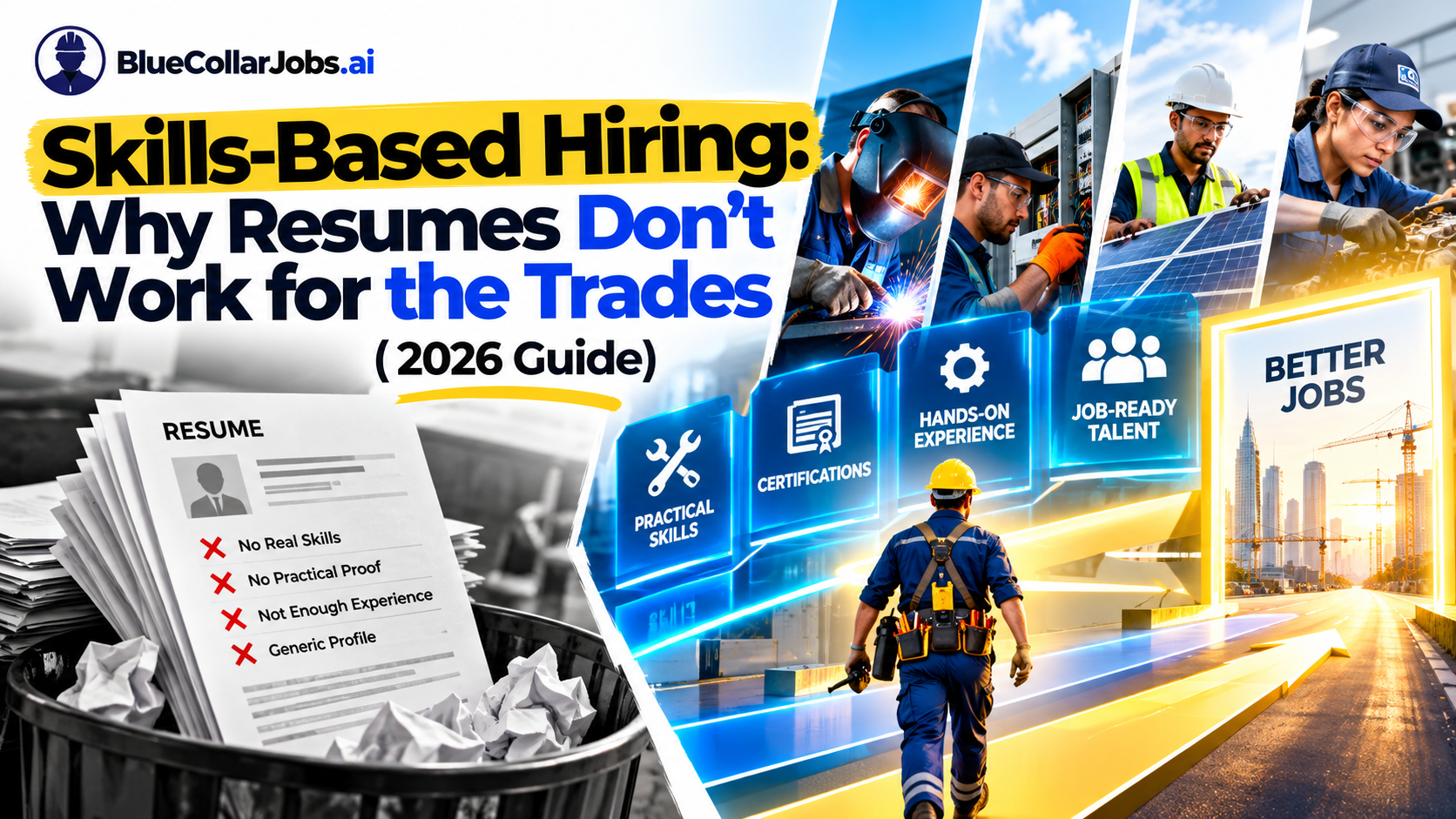
Skills-Based Hiring
Introduction:
A resume tells you where someone has worked. It does not tell you whether they can do the work. For most white-collar roles, that gap is manageable. For a skilled tradesperson — an electrician, a welder, an HVAC technician — it makes the entire hire process fundamentally unreliable.
Skills-based hiring exists to close that gap. And in 2026, it is becoming the standard for every industry where what someone can do matters more than what their last job title was.
What Is a Skill? (And Why the Answer Changes Everything)
A skill is a specific, demonstrable ability to do something — weld a pipe, wire a distribution board, operate a CNC machine, diagnose an HVAC fault. Skills are not listed on a resume. They are proven through certification, trade testing, practical assessment, or verified work history.

This is the core problem with resume-based hiring for trades: a resume describes employment. A skill describes capability. The two are not the same thing — and confusing them is exactly why the trades sector has an average time-to-hire of 56 days (Blue Collar Business Podcast, 2026), and why most industries see blue-collar attrition of over 15% per month (Deloitte India, 2025).
Resume Hiring vs Skills-Based Hiring: A Direct Comparison
Factor | Resume-Based Hire | Skills-Based Hire |
|---|---|---|
What it evaluates | Job titles, employer names, years of experience | Certified trade ability, practical test results, verified skill record |
Who it favours | Workers who write well and had prestigious employers | Workers who can actually do the job |
Time-to-hire | 40–60 days average | 14–21 days with skill-verified shortlisting |
First-year attrition risk | High — mismatches found after placement | Lower — match is based on actual capability |
Fit for skilled trades | Poor — trades expertise doesn't translate to documents | Strong — trade certifications are objective, verifiable |
Fit for India's workforce | Excludes 95% who lack formal education (5% formally trained) | Includes anyone with verified trade skill |
Why the Trades Are Leading the Shift to Skills-Based Hiring
92% of employers who use skills-based assessments report they are more effective at identifying talent than CVs (TestGorilla, 2023). Nearly 70% of firms in the blue-collar sector now focus on demonstrated ability over credentials (Blue Collar Business Podcast, 2026).
This is not idealism. It is a response to a real crisis.
India currently faces a shortage of 150 million skilled workers — not because the people aren't there, but because the system consistently fails to match them to the right roles. Sectors can only fill 80% of their needs despite hiring 500,000 blue-collar workers per month (Foundamental, 2024). The mismatch is structural.
Skills-based hiring solves this by evaluating workers on what they can do, verified through trade certifications, ITI credentials, practical assessments, or employer-confirmed experience — not on whether they formatted a document well.
What Skills-Based Hiring Actually Looks Like in Practice
Stage | Traditional Resume Approach | Skills-Based Hiring Approach |
|---|---|---|
Application | Worker submits CV; filtered by keywords | Worker submits trade certificate and skill profile |
Screening | Recruiter reads work history | System verifies certification category and trade level |
Shortlisting | Based on company names and job titles | Based on certified skill match to role requirements |
Interview | Focuses on past roles and soft questions | Includes practical or scenario-based trade assessment |
Placement | Based on best-fit document | Based on verified capability, location, and availability |
Outcome | High mismatch rate, high early attrition | Better placement quality, lower churn |
Why Location and Availability Are Also Skills-Based Factors
A skilled trade worker is not interchangeable the way an office worker might be. Their value is tied to where they can work, when they are free, and what specific trade they are certified in.
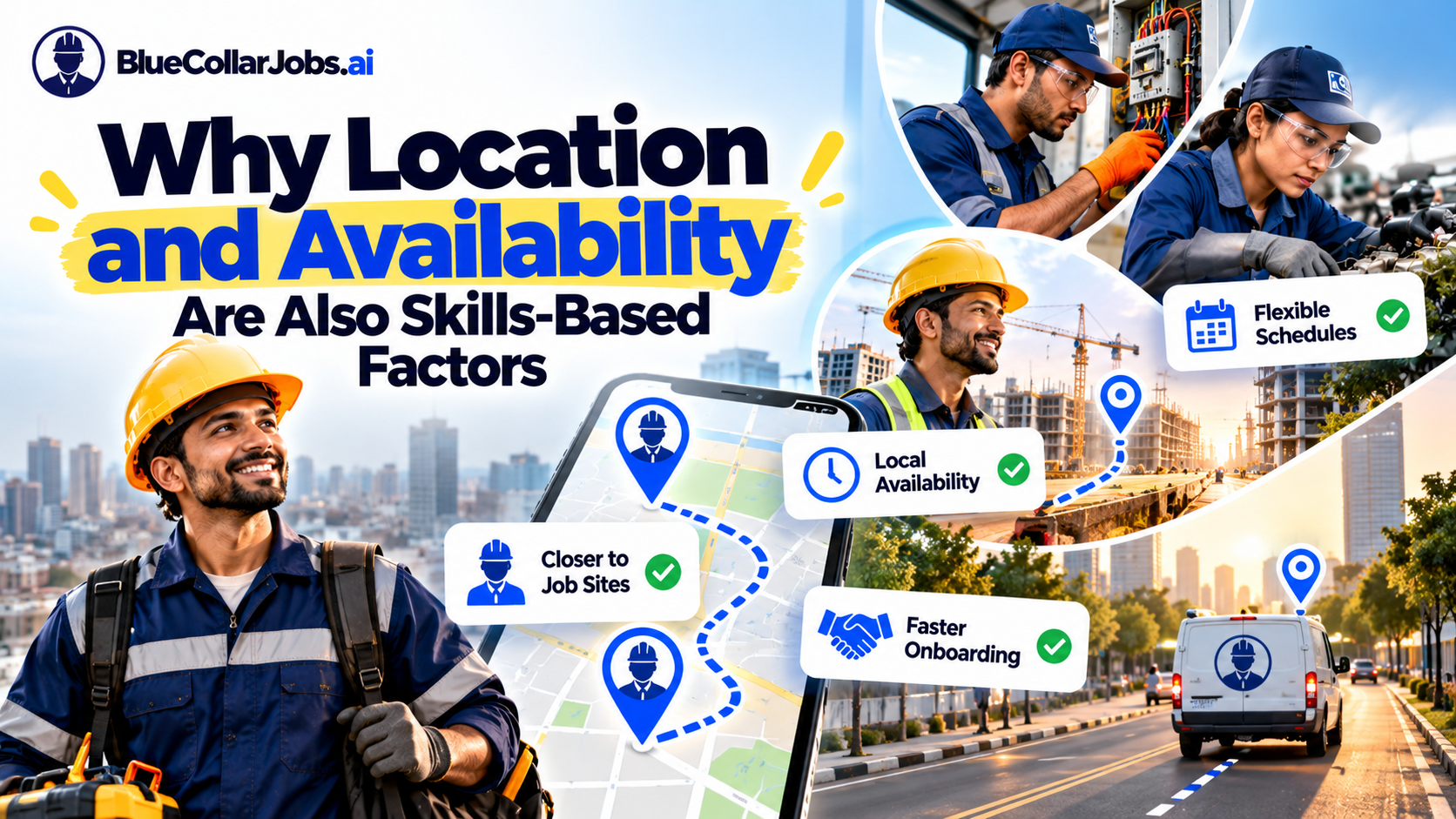
Skills-Based Hiring
Skills-based hiring for trades always combines three variables: what the worker can do, where they are, and when they are available. Evaluating any one of these in isolation produces a bad hire.
This is the model that BlueCollarJobs.ai is built on. The platform does not ask tradespeople to compete via a formatted CV. It collects their trade certification, location, and availability — and matches them directly with verified employers across India, the Gulf, Germany, Australia, and beyond. Employers get a skills-verified candidate. Workers get direct access to a real job. The entire skills-based hire process is transparent at every step.
Indian workers register for ₹1,000. International workers join for $20. No agents. No resume filters. Just a direct match based on what someone can actually do.
The Data Confirms the Direction
India's national employability reached 56.35% in 2026 — up from 54.81% in 2025 (India Skills Report 2026)
Project-based and skills-first hiring is up 38% in the past year (India Skills Report 2026)
70% of the 90 million new jobs India will create by 2030 will be blue-collar (McKinsey, BW People)
30% of Indian companies are removing degree requirements entirely and moving to skills-first criteria (NeoIntelli, 2026)
The direction is clear. The trades do not need better resumes. They need a better way to hire — and skills-based hiring is it.
Frequently Asked Questions
1. What is skills-based hiring?
Skills-based hiring is a recruitment approach that evaluates candidates on their verified, demonstrated ability to do a specific job — rather than on their job title history, degree, or employer background. For trades workers, this means using trade certifications, ITI credentials, practical assessments, and verified work records as the basis for a hire decision.
2. Why don't resumes work for skilled trades?
Resumes were designed for careers built around job titles, companies, and academic qualifications. Skilled tradespeople — electricians, welders, plumbers, HVAC technicians — carry their value in practical certified ability, not documents. Resume-based hiring filters them out before a decision-maker ever reviews them, which is a primary reason India faces a 150-million skilled worker placement gap despite having enough workers.
3. What is a skill, and how is it different from a qualification?
A skill is a specific, verifiable ability to perform a task — weld, wire, machine, install, repair. A qualification is a document confirming you studied something. In trades, skills and qualifications often overlap (an ITI certificate confirms a demonstrated skill), but the skill is what the employer actually needs. Skills-based hiring evaluates the skill directly — through certification, testing, or employer-verified record — rather than assuming a qualification proves capability.
4. How does skills-based hiring reduce attrition in blue-collar roles?
When a hire is based on verified skill, location, and availability — rather than a CV match — the resulting placement is more accurate. Workers placed correctly stay longer. India's blue-collar sector currently sees monthly attrition of over 15% (Deloitte India, 2025), largely driven by placement mismatches. Skills-based hiring reduces these mismatches because the matching variables reflect real-world fit, not document proximity.
5. How does BlueCollarJobs.ai support skills-based hiring?
BlueCollarJobs.ai removes the CV from the blue-collar hire process entirely. Workers submit their trade certification, location, and availability. Employers post verified openings. The platform matches them directly on skills — not job title history. This means a certified electrician in Bhopal, a trained welder in Nagpur, or an HVAC technician in Hyderabad can access verified employers in India and internationally without ever needing to write or format a resume. It is skills-based hiring applied at scale, for the people who need it most.
Sources:
Deloitte India — Blue Collar Workforce Trends 2025 (May 2025)
Blue Collar Business Podcast — Blue Collar Business Trends 2026 (May 2026)
TestGorilla — The State of Skills-Based Hiring 2023 (Fortune, November 2023)
Taggd — Blue Collar Jobs in India: The 2026 CHRO Hiring Guide (June 2026)
Careers360 — India Skills Report 2026: Employability Reaches 56.35%
BW People — Blue Collar Jobs to Drive 70% of India's New Job Growth By 2030 (McKinsey)
NeoIntelli — AI Skill Trends India 2026: 30% of Indian Companies Using Skills-Based Hiring