
Skilled Labour vs Unskilled Labour: What the Terms Actually Mean and Why It Matters
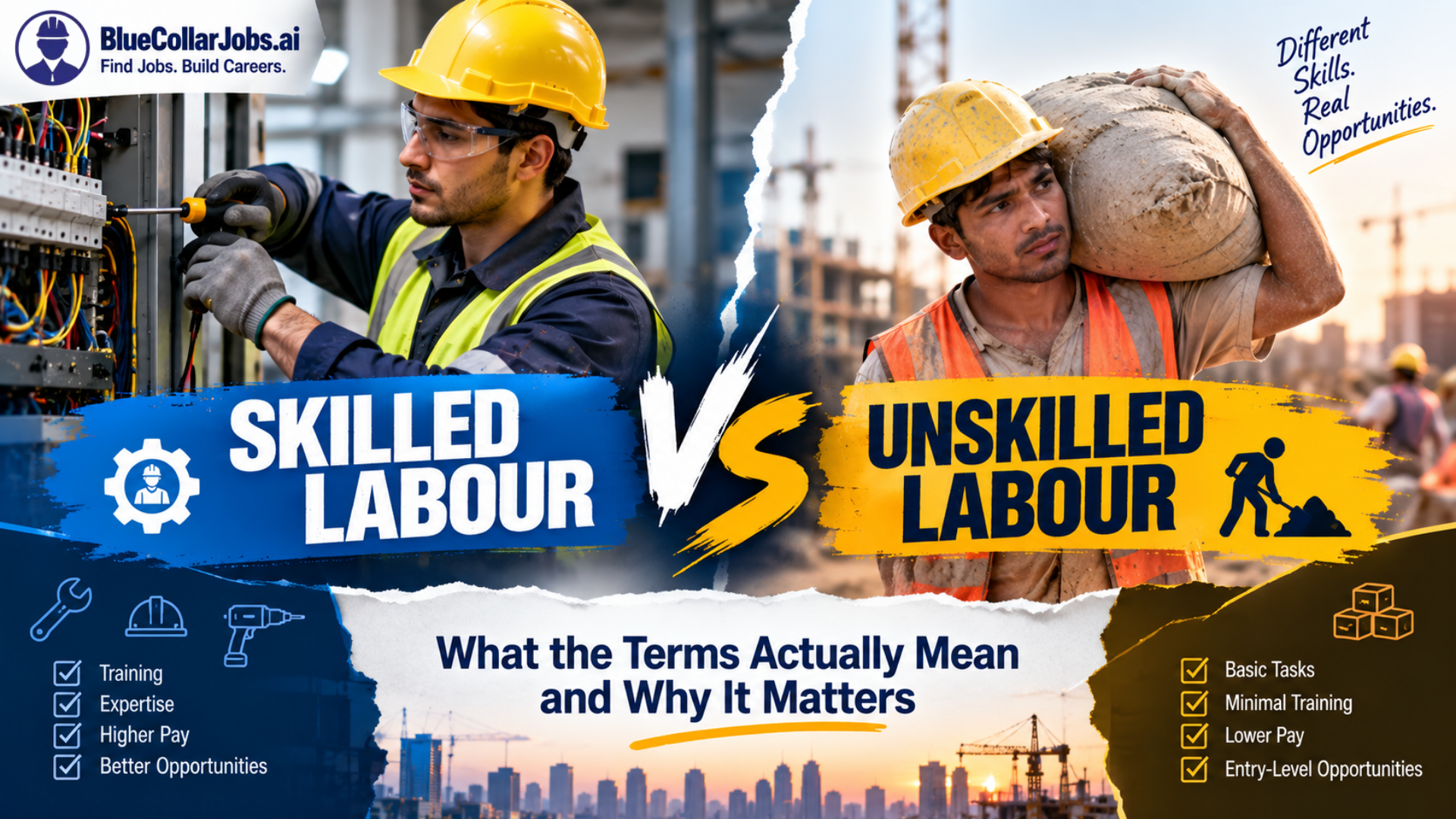
Skilled Labour vs Unskilled Labour
The words skilled and unskilled get used every day in job listings, government documents, and salary discussions — but most people have never been clearly told what they actually mean, how they are defined in Indian law, and why the distinction has a direct and significant effect on what you earn. This article clears all of that up, in plain language. And if you are a skilled worker looking for your next opportunity, BlueCollarJobs.ai is the platform built to connect you with verified employers who recognise — and pay for — the difference.
Why the Skilled vs Unskilled Labour Distinction Matters in 2026
The distinction between skilled and unskilled labour is not just academic. Under India's Code on Wages, 2019 — which consolidates four earlier labour laws into a single framework — workers are formally classified into four categories, and minimum wage rates are set differently for each.

Skilled Labour vs Unskilled Labour
In November 2025, approximately 40,000 workers protested in Noida over a wage disparity between Uttar Pradesh and neighbouring Haryana. Haryana had announced a 35% wage hike bringing its unskilled minimum to ₹15,220 per month, while UP's rate stood at ₹11,313 — a gap of nearly ₹4,000 per month for the same work. In response, UP raised its rate by 21% to ₹13,690 effective April 2026. The category a worker is placed in — skilled vs unskilled labour — determined which rate they received.
This is why the terminology matters. It is not just a label. It determines your legal minimum wage, your hiring eligibility, and your long-term earning potential.
The Four Official Categories | Clearly Explained
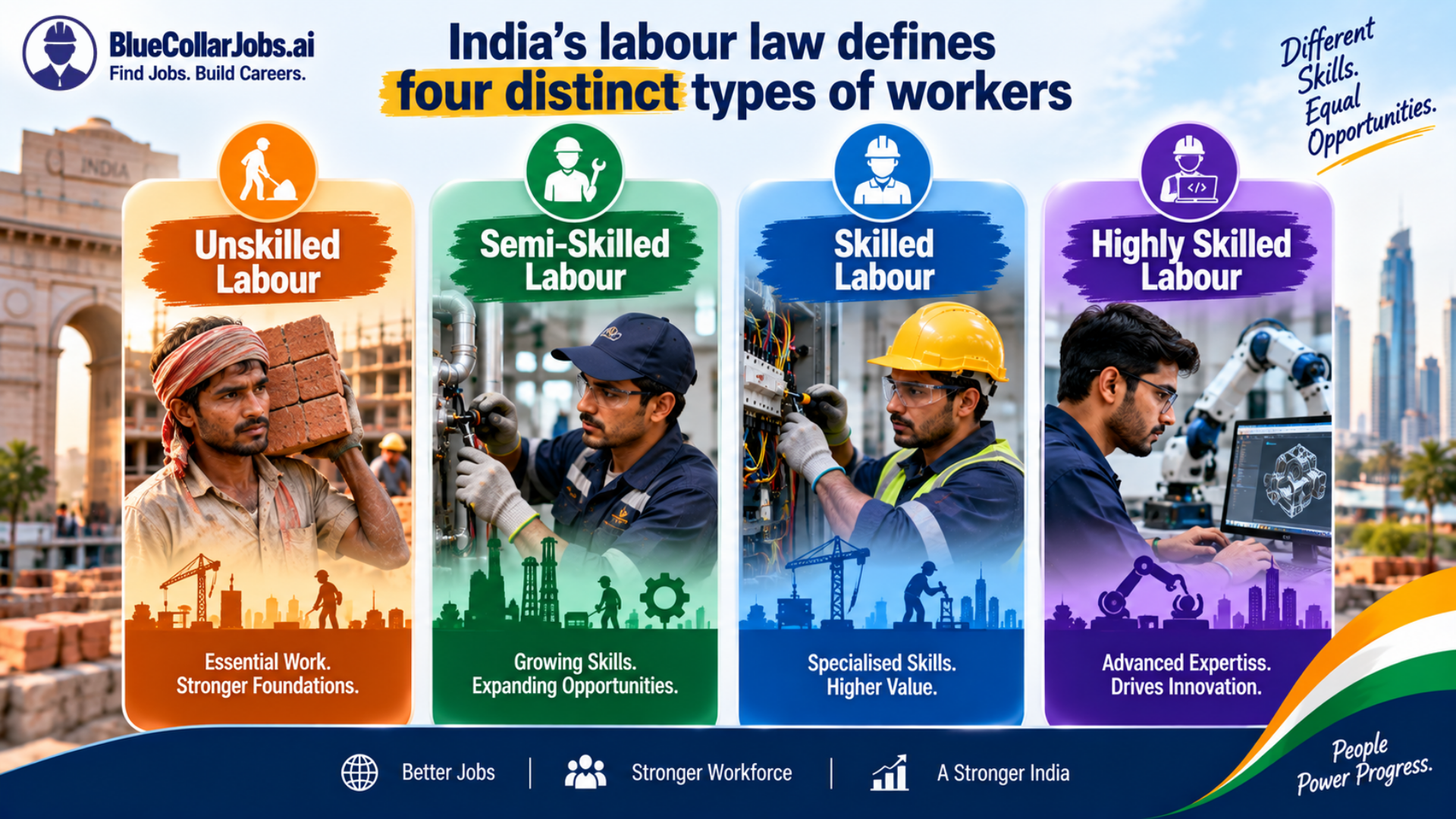
India's labour law defines four distinct types of workers:
Skilled Labour vs Unskilled Labour
Unskilled Labour: An unskilled worker performs simple, routine tasks that require no prior experience or formal training. They may need brief initial orientation to understand the tools and work environment, but no specialist qualification is expected. The central government minimum wage for unskilled workers is set at ₹783 per day (approximately ₹20,358 per month). State rates vary — in 2026, the range across major states runs from ₹11,389 to ₹19,846 per month for unskilled roles.
Semi-Skilled Labour: A semi-skilled worker can perform most tasks in their area of work but requires additional training or supervision for advanced functions. They have some knowledge and ability beyond the unskilled level but have not yet reached the independent proficiency of a skilled worker. This is often the category where trained ITI students begin before gaining experience.
Skilled Labour: A skilled worker can carry out specific tasks with little or no assistance. They have expertise in their trade, can deliver high-quality results efficiently, and typically hold a recognised qualification, an ITI certificate, an NCVT credential, or a trade-specific licence. The minimum wage for skilled labour is set higher than both unskilled and semi-skilled categories, and actual market wages for skilled workers frequently exceed these minimums significantly.
Highly Skilled Labour: The highest formal category. Highly skilled workers hold advanced specialisations, often backed by years of trade experience and additional certifications. The central government sets their daily minimum at ₹1,035 per day — and in competitive sectors like CNC programming, electrical automation, and HVAC, actual salaries run far above this floor.
The Key Insight Most People Miss
The line between unskilled and skilled labour is not permanent. It is not something fixed at birth or decided by family background. It is determined entirely by training, certification, and experience — all of which are accessible, affordable, and often completable in two years or less through India's ITI and NSQF certification systems.
A young person who begins as unskilled labour on a construction site today can, with an ITI certificate in electrical work, legally and formally become a skilled worker — with a higher minimum wage, stronger hiring prospects, and access to international job markets including Gulf countries, Germany, and Australia.
Research from the Indian Institute of Foreign Trade (2024) confirms that AI is widening the wage gap between skilled and unskilled workers across low and middle-income economies. The workers who certify and upskill move into the protected side of that gap. Those who do not are increasingly exposed to wage stagnation and displacement.
How BlueCollarJobs.ai Helps Skilled Workers Find the Right Employer
Understanding where you sit on the skilled vs unskilled labour spectrum is the first step. The second is finding an employer who values and pays for your skill level accurately.

Skilled Labour vs Unskilled Labour
BlueCollarJobs.ai connects certified skilled labour — electricians, welders, plumbers, HVAC technicians, CNC operators, and construction professionals — directly with verified employers in India and internationally. Every listing on the platform is attached to a real, screened company. Every skilled worker gets a transparent view of the role, the salary, and the process before committing.
No fake listings. No agents who misrepresent skill requirements or suppress wages. No confusion about whether the employer is legitimate.
Indian workers — Register for just ₹1,000
International workers — Join for just $20
The difference between skilled and unskilled labour is real, legal, and financially significant. BlueCollarJobs.ai ensures that skilled workers are placed — and paid — accordingly.
Visit bluecollarjobs.ai — Register today and find opportunities that match your skill level.
Frequently Asked Questions
1. What is skilled labour?
Skilled labour refers to workers who can perform specialised tasks independently, with expertise and precision, and typically hold a recognised trade qualification such as an ITI certificate or NCVT credential. In Indian law, they are classified as a distinct wage category under the Code on Wages, 2019, and receive a higher mandated minimum than semi-skilled or unskilled categories.
2. What is unskilled labour?
Unskilled labour refers to work that requires no prior experience or formal training. Unskilled workers perform basic, routine tasks and may need brief initial orientation. The central government minimum wage for unskilled workers in India is ₹783 per day (₹20,358 per month), with state rates varying from ₹11,389 to ₹19,846 per month across major states in 2026.
3. What is semi-skilled labour?
Semi-skilled labour sits between unskilled and skilled. A semi-skilled worker can handle most tasks in their area of work but requires supervision or additional training for more advanced functions. Many ITI graduates begin at this level before accumulating the experience to be formally classified as skilled.
4. Skilled meaning in Hindi
In Hindi, ‘Skilled’ is translated as ‘कुशल’ (Kushal), meaning proficient, expert, or well-trained. Skilled labour in Hindi is कुशल श्रम (Kushal Shram).
Unskilled meaning in Hindi
In Hindi, ‘Unskilled’ is translated as ‘अकुशल’ (Akushal), meaning lacking formal expertise or training. Unskilled labour in Hindi is अकुशल श्रम (Akushal Shram). These terms are used in official government wage notifications and labour department documents across India.
5. What is the actual wage difference between skilled vs unskilled labour in India?
The central government minimum wage gap in 2026 stands at ₹783/day (unskilled) to ₹1,035/day (highly skilled), a difference of over 32% at the floor level. In practice, the real-world gap is considerably wider. An unskilled helper on a construction site may earn ₹12,000–₹15,000 per month, while a skilled electrician or CNC operator in the same city earns ₹40,000–₹80,000 or more. Internationally, a certified skilled Indian worker in the Gulf earns AED 2,000–3,500 per month — effectively two to three times what the same uncertified worker earns domestically.
Sources:
FactoHR — Minimum Wages in India 2025–26: Skill Category Definitions and Rates (November 2025)
EmploySome — Minimum Wage in India 2026: State Rates and Employer Guide (May 2026)
Shankar IAS Parliament — Rising Gap Between Low and High Skill Jobs in India (September 2024)
Saral.pro — Minimum Wage and Salary in India: State Wise Rates and Labour Law Details (December 2025)
Sanskriti IAS — Periodic Labour Force Survey (PLFS) 2025: Gender Wage Gap in India (2026)