
Gulf Job & Salary Trends for Skilled Workers in 2026 — What You Need to Know Before You Apply
Gulf Jobs & Salary Trends
Introduction: Gulf Job & Salary Trends for Skilled Workers in 2026
Here is a truth most people do not say out loud: Gulf job are the single most accessible path to income transformation for a skilled worker in India right now. Tax-free earnings, company-provided housing, food allowances, and medical insurance — all in countries that are spending trillions on their biggest-ever infrastructure programmes. Jobs in Gulf countries: The demand for skilled workers in Gulf countries has never been higher.
And BlueCollarJobs.ai is the platform that connects verified workers to these opportunities, directly, safely, and without middlemen.
Why Gulf Jobs in GCC Countries Are Booming in 2026
The numbers speak for themselves.
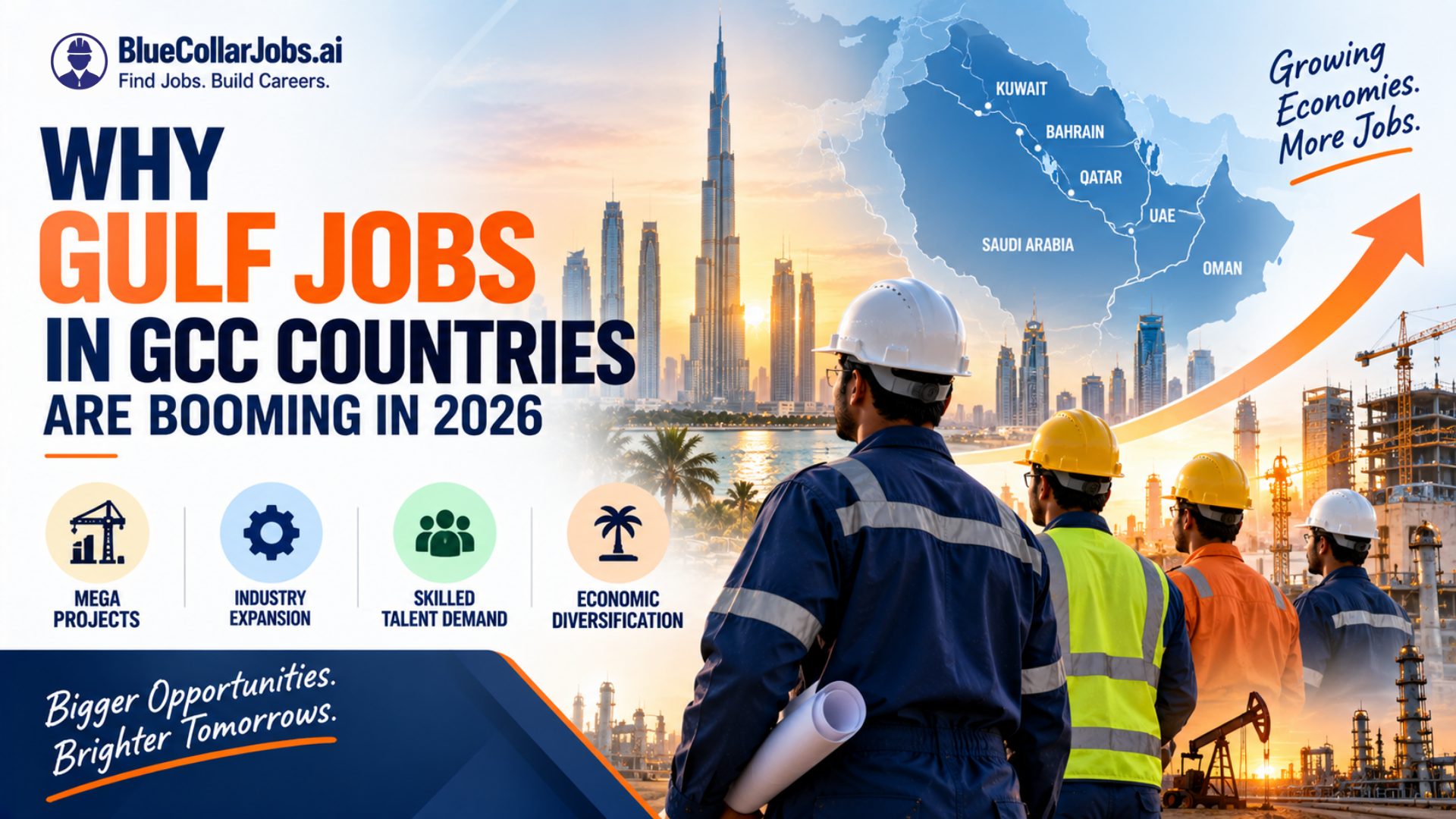
The six GCC nations — UAE, Saudi Arabia, Qatar, Kuwait, Oman, and Bahrain — collectively need to hire an estimated 2.5 million skilled professionals over the next three years, according to Gulf Talent's 2025–2026 Employment Report. The region is expected to create 5+ million new private-sector jobs by 2030. The UAE alone ranks #1 globally in hiring sentiment, with 56% of employers actively planning workforce expansion in 2026.
Gulf Jobs & Salary Trends
Saudi Arabia's Vision 2030 — home to megaprojects like NEOM, Red Sea Global, Qiddiya, and Diriyah Gate — is projected to create 920,000 jobs by 2030. NEOM alone is hiring 50,000+ roles cumulatively across engineering, construction, operations, and skilled trades. Qatar issued more than 50,000 new work visas in Q1 2026 alone.
Gulf salary benchmarks are rising across the board too. Saudi Arabia is projecting the highest salary increase in the GCC at 4.6%, followed by Qatar at 4.3% and the UAE at 4.1%. Mid-senior professionals are commanding packages 15 to 25% higher than 2023 benchmarks — and for skilled trade workers, the total compensation picture is even better once housing, food, and insurance are added.
Gulf Salary Guide 2026 — What Skilled Workers Actually Earn in GCC Countries
One of the biggest advantages of a Gulf job is that most blue-collar and trade contracts include company-provided housing, food allowances, and medical insurance — meaning workers keep almost everything they earn.
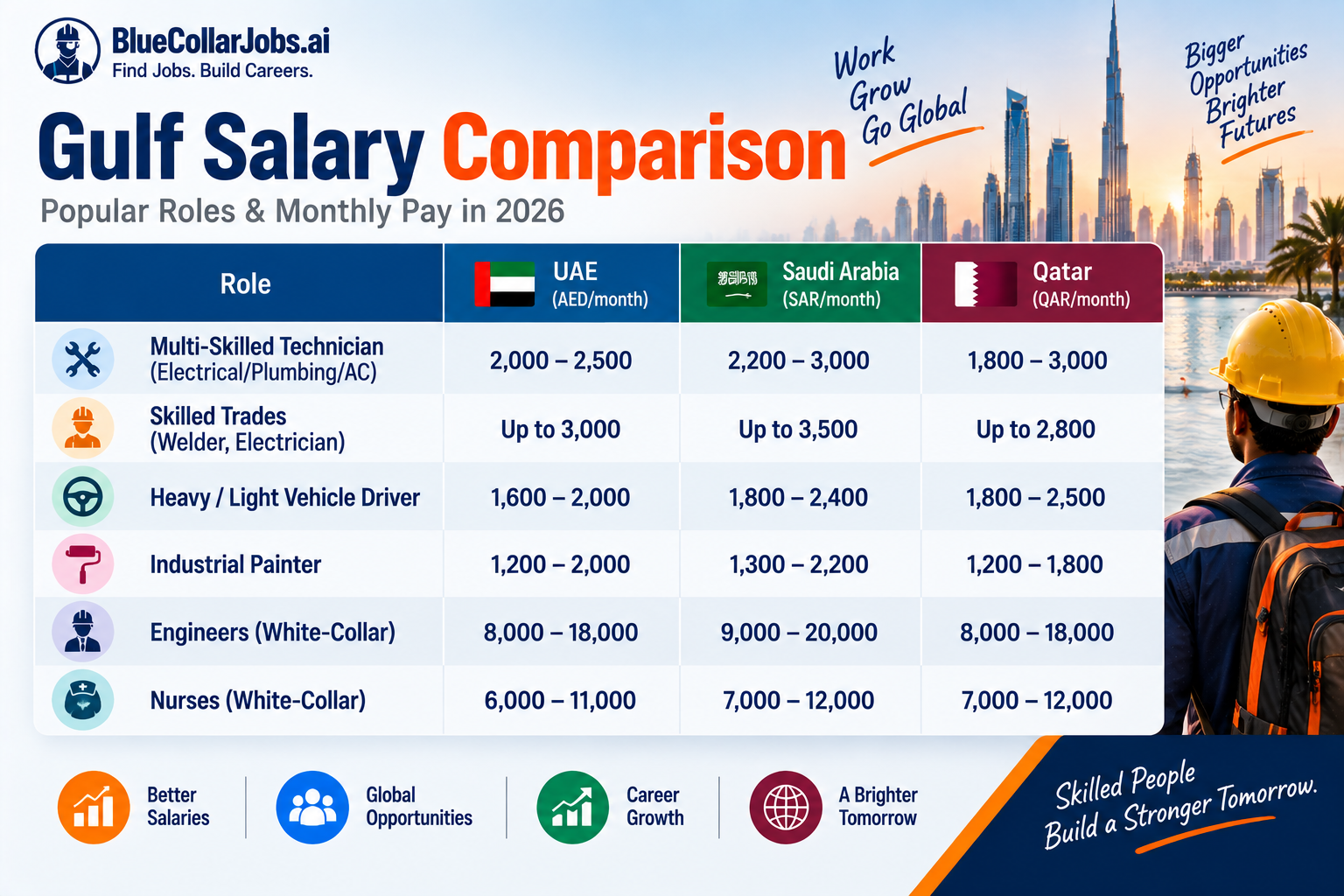
Here is the Gulf salary breakdown by role and country:
Gulf salary breakdown by role and country
When accommodation, food, and medical are included, the effective earning power of a skilled trade worker in the Gulf is often two to three times what a comparable role pays in India — with no income tax deducted.
Top Sectors Offering Jobs in Gulf Countries Right Now
Construction and Infrastructure — NEOM alone needs welders, pipefitters, HVAC specialists, and electricians by the tens of thousands. The biggest Gulf job pipeline in 2026 runs through construction.
Oil and Gas / Energy — Continuous intake of instrumentation technicians, fitters, and specialised operators across Saudi Arabia, Kuwait, and Oman.
Healthcare — Urgently hiring nurses, lab technicians, radiographers, and specialised clinicians across all six GCC countries.
Logistics and Transport — Consistent openings for heavy and light vehicle drivers, forklift operators, and warehouse staff — one of the most accessible entry points for jobs in Gulf countries.
IT and Digital Transformation — Growing demand for software engineers and system support professionals as the UAE accelerates its AI hub ambitions and Saudi Arabia builds out its tech infrastructure under Vision 2030.
Our Honest Opinion: How to Get Gulf Jobs and the Gulf Salary You Actually Deserve
Most skilled workers in India know about the Gulf. But they stay stuck because they do not know who to trust. Fake agents, inflated fees, misleading contracts, and horror stories hold back thousands of qualified workers every year.
This is the problem BlueCollarJobs.ai was specifically built to eliminate.
The platform connects electricians, welders, HVAC technicians, drivers, plumbers, CNC operators, and other skilled workers directly with verified employers across all six GCC countries — UAE, Saudi Arabia, Qatar, Kuwait, Oman, and Bahrain. Every employer is screened. Every Gulf salary figure is accurate. Every step of the process is fully visible before you commit.
There are no middlemen skimming your wages. No fake listings wasting your time. No confusion about what the contract says.
Indian workers — Register for just ₹1,000
International workers — Join for just $20
The Gulf jobs market in 2026 is the best it has ever been for skilled workers. The only thing standing between you and it is the right platform.
Visit BlueCollarJobs.ai — Register today and find your Gulf job.
One Thing Nobody Warns You About — And Our Honest Take on Gulf Jobs
Here is something worth saying clearly, because most platforms will not say it.
The Gulf jobs market is genuinely one of the best opportunities available to a skilled Indian worker today. The pay is competitive. The benefits are real. The demand is growing year after year. But the path to get there is broken — and that broken path is costing thousands of skilled workers the opportunity they have already earned.

Gulf Jobs & Salary Trends
Fake recruitment agents. Inflated processing fees. Job offers that turn into completely different contracts once you land. These are not rare horror stories. They happen every single week to workers who had every right to a better outcome.
Our honest opinion? The Gulf is worth it — but only if you go through a process that is transparent, verified, and honest from day one. A skilled electrician or welder going to the UAE through a legitimate employer with a proper contract, housing included, and a documented Gulf salary is making one of the smartest financial decisions of their working life. The same worker going through an unlicensed agent is gambling everything they have saved. The difference between these two outcomes is not luck. It is the platform they chose to trust.
What Gulf Countries Value Most in 2026 — Skills That Command a Higher Gulf Salary
The Gulf salary you earn is directly tied to the skills you bring. In 2026, GCC employers are paying a clear premium for workers with technical qualifications over those without.
Workers who hold any of the following are consistently offered higher starting packages in jobs in Gulf countries:
CSWIP or AWS welding certification — commands a premium over uncertified welders in Saudi and UAE
Electrical trade license (ITI + NCVT) — instantly verifiable and trusted by Gulf employers
HVAC certification — critical shortage role, especially in UAE and Qatar
Forklift operator license — simple to obtain in India, highly valued in Gulf logistics roles
Gulf-specific safety training (NEBOSH or OSHA) — significantly improves offer quality in construction Gulf jobs
This is the hidden truth of the Gulf salary market: two workers applying for the same role with the same years of experience can receive offers that are AED 300–500 apart per month simply because one has a recognised certification and the other does not. That difference, over a two-year contract, is a significant amount of money.
Certify before you go. It pays — literally.
FAQs — About Jobs in Gulf Countries Answered
Q1. Which Gulf country has the most job opportunities for skilled workers in 2026?
Saudi Arabia leads in sheer volume of Gulf jobs due to Vision 2030 megaprojects — NEOM, Red Sea, Qiddiya, and Diriyah Gate are all actively hiring. The UAE offers the widest range across sectors. Qatar continues issuing large numbers of work visas — over 50,000 in Q1 2026 alone. All six GCC countries are actively hiring skilled workers right now.
Q2. What is the Gulf salary for a skilled tradesperson in 2026?
A skilled Gulf salary for trades like welding, electrical work, or HVAC ranges from AED 2,000–3,000 in the UAE, SAR 2,200–3,500 in Saudi Arabia, and QAR 1,800–3,000 in Qatar. Most contracts also include free housing, food allowances, and medical insurance, making effective take-home pay significantly higher than the base figures suggest.
Q3. Are Gulf jobs tax-free for Indian workers?
Yes - UAE, Saudi Arabia, Qatar, Kuwait, Oman, and Bahrain all offer tax-free salaries for expatriate workers. There is no personal income tax in any of the six GCC countries, meaning workers keep their full Gulf salary with no deductions on earnings.
Q4. What documents do I need to apply for jobs in Gulf countries?
For jobs in Gulf countries, you typically need a valid passport, trade certificate or ITI qualification, updated CV, medical fitness certificate, and police clearance certificate. Some roles require additional Gulf-specific trade tests or skill assessments at embassies or testing centres.
Q5. How does BlueCollarJobs.ai help me find verified Gulf jobs?
BlueCollarJobs.ai connects skilled Indian workers directly with verified employers across all GCC countries. The platform shows you real Gulf jobs, accurate Gulf salary information, and a fully transparent hiring process — with no middlemen, no fake listings, and no hidden fees. Register for ₹1,000 and get direct access to jobs in Gulf countries right now.
Sources:
Allianz EHR — Skilled Worker Salary Trends in GCC 2026 Guide
Huntlo — Gulf Hiring Trends 2026: What Recruiters Need to Know (July 2026)
People Connect Global — UAE & GCC Hiring Outlook 2025–2026 (October 2025)
Gulf Business — UAE Salary Rise 2026 Forecast (November 2025)
Best Job Search Apps — Which Gulf Country Is Best for Jobs in 2026 (April 2026)