
The Future of Blue-Collar Jobs: How AI, Automation, and Robotics Are Actually Changing the Trades
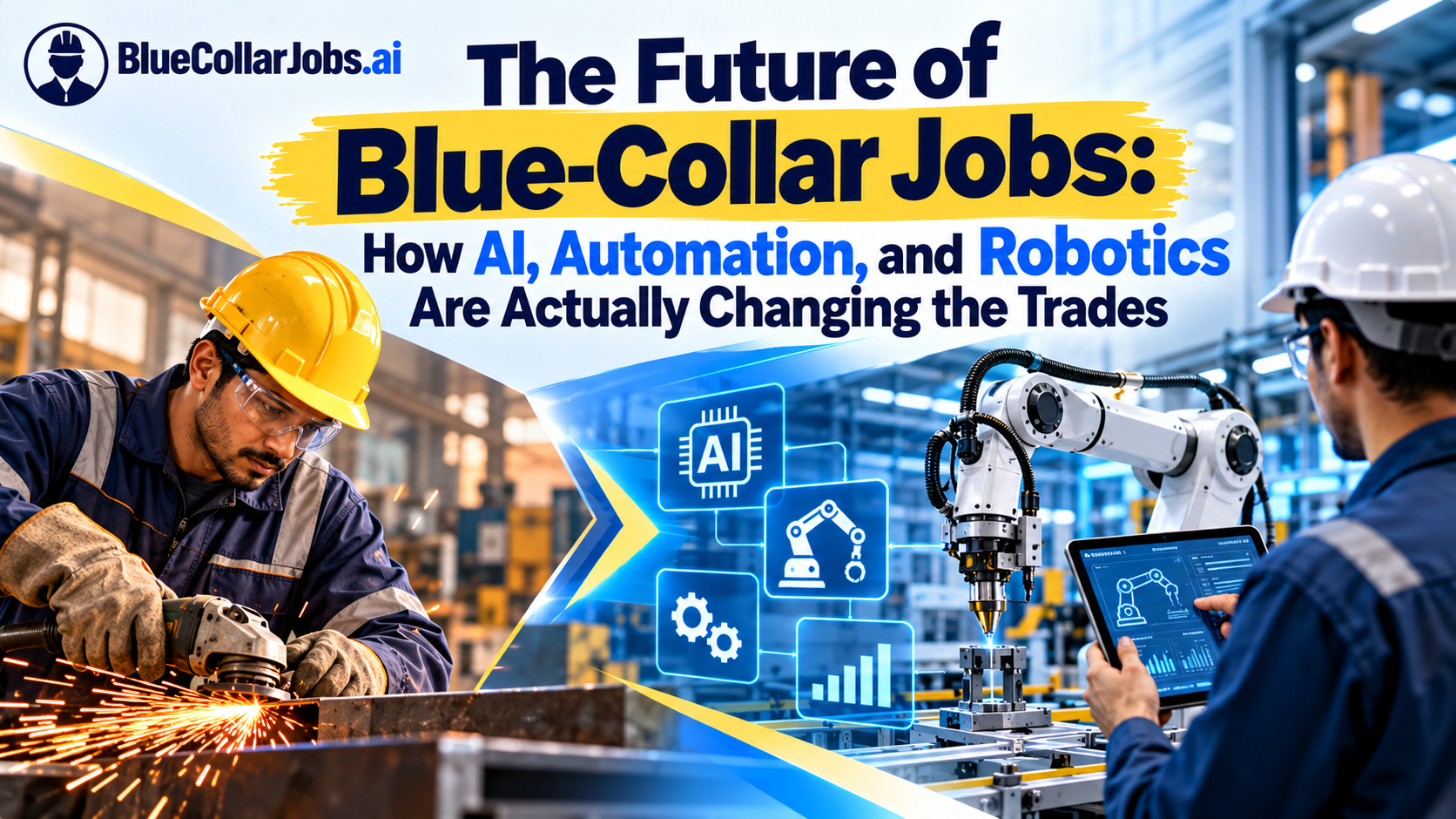
Future of Blue-Collar Jobs
Here is the part of the AI jobs story that almost nobody is telling correctly: the workers facing the most immediate risk from artificial intelligence are not electricians, plumbers, or welders. They are entry-level programmers, financial analysts, and call centre agents.
The future of blue-collar jobs is not the disaster most people imagined. It is something considerably more interesting — a structural shift that is eliminating repetitive tasks, creating highly technical new ones, and forcing a long-overdue rethink of what skilled trades work actually means.
What AI Is Actually Replacing — And What It Cannot
Ford CEO Jim Farley said it plainly on September 30, 2026: "If you work in finance doing spreadsheets, or you're in a call centre, or you're an entry-level programmer — those jobs are definitely going to be changed and eliminated."
But blue-collar jobs? "I think most of these jobs will be both using AI and also protected from it," Farley said. He described AI as a "companion" for trade workers — a tool that improves diagnostic capability and precision, without replacing the human who climbs into the ceiling, troubleshoots the fault, and makes the call on the spot.
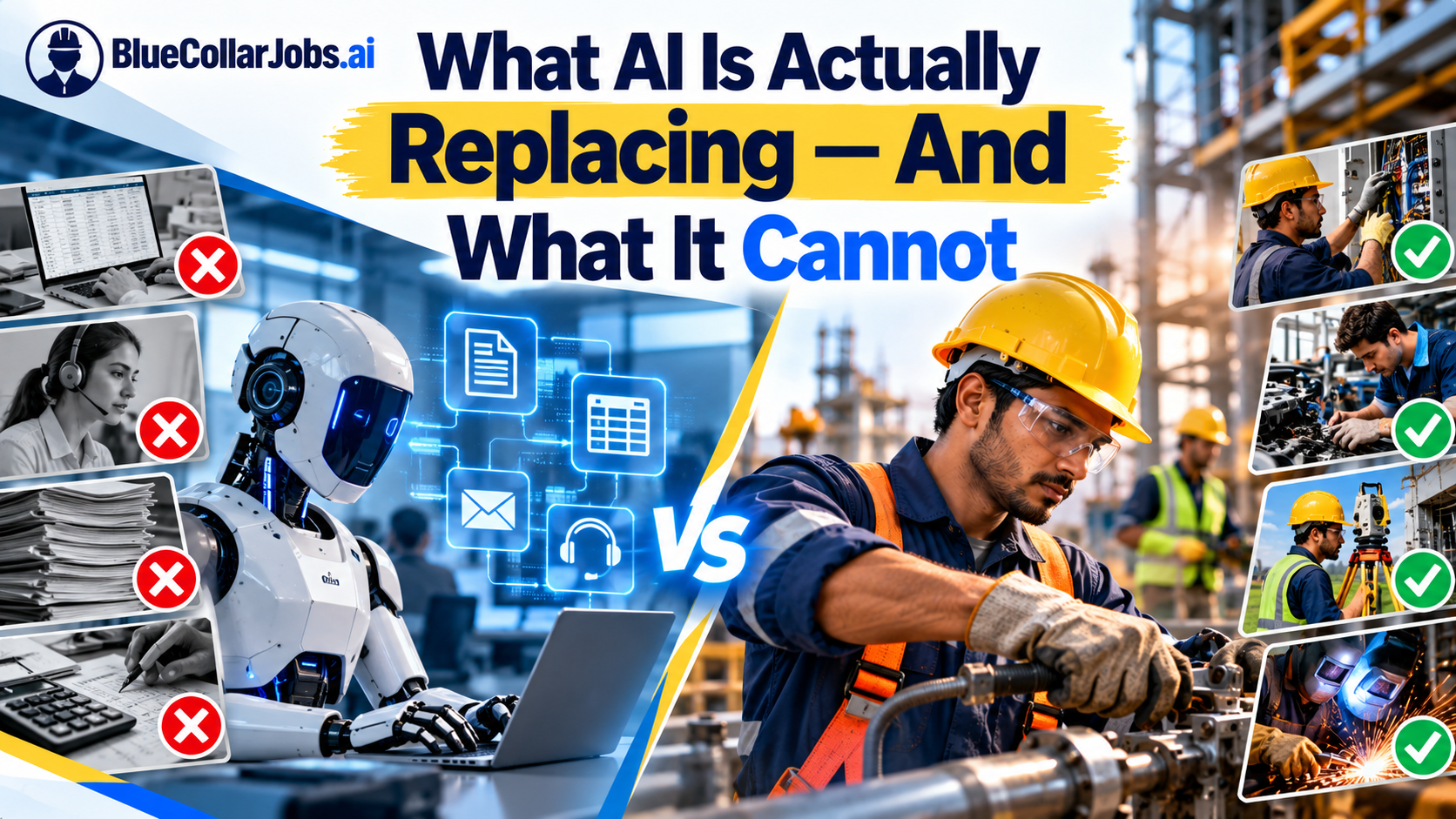
This is the key distinction that gets lost in the noise. AI is extremely effective at standardised, screen-based, rule-following tasks. It is not — yet, and perhaps not for a long time — able to diagnose a leaking pipe inside a century-old wall, rewire a distribution board in a live commercial building, or identify why a CNC machine is producing micro-deviations on a Tuesday morning when it worked perfectly on Monday.
The World Economic Forum's Future of Jobs Report 2025 puts a number on this: skilled trades carry a disruption risk classified as "Very Low", with a net job impact projected at +10% to +20% growth through 2030. Compare that to paralegal document reviewers (-25% to -40%) or junior software developers (-15% to -30%).
The Jobs That Are Genuinely at Risk in the Trades
To be honest about the future of blue-collar jobs, it is worth naming what automation will change.
Repetitive, highly predictable tasks within manufacturing — feeding materials into machines, packing identical components, conducting standardised quality checks on an unchanging production line — are genuinely at risk. The International Federation of Robotics reports that over 500,000 new industrial robots were installed globally in 2024. Since 2000, automation has already displaced approximately 1.7 million manufacturing jobs in the US alone.
The workers who face the most exposure are those whose entire job is a single repeated task, performed in a controlled, predictable environment. That role is being redesigned around a machine that does the repetition — supervised by a person who manages, troubleshoots, and intervenes when something goes wrong.
This is not job elimination. It is job transformation.
The New Blue-Collar Worker
Randstad's research projects that by 2033, nearly 1.9 million manufacturing jobs in the US alone may go unfilled — not because automation eliminated demand, but because the roles that exist require skills that have not been trained for. The future of blue-collar jobs is not fewer workers. It is different workers.
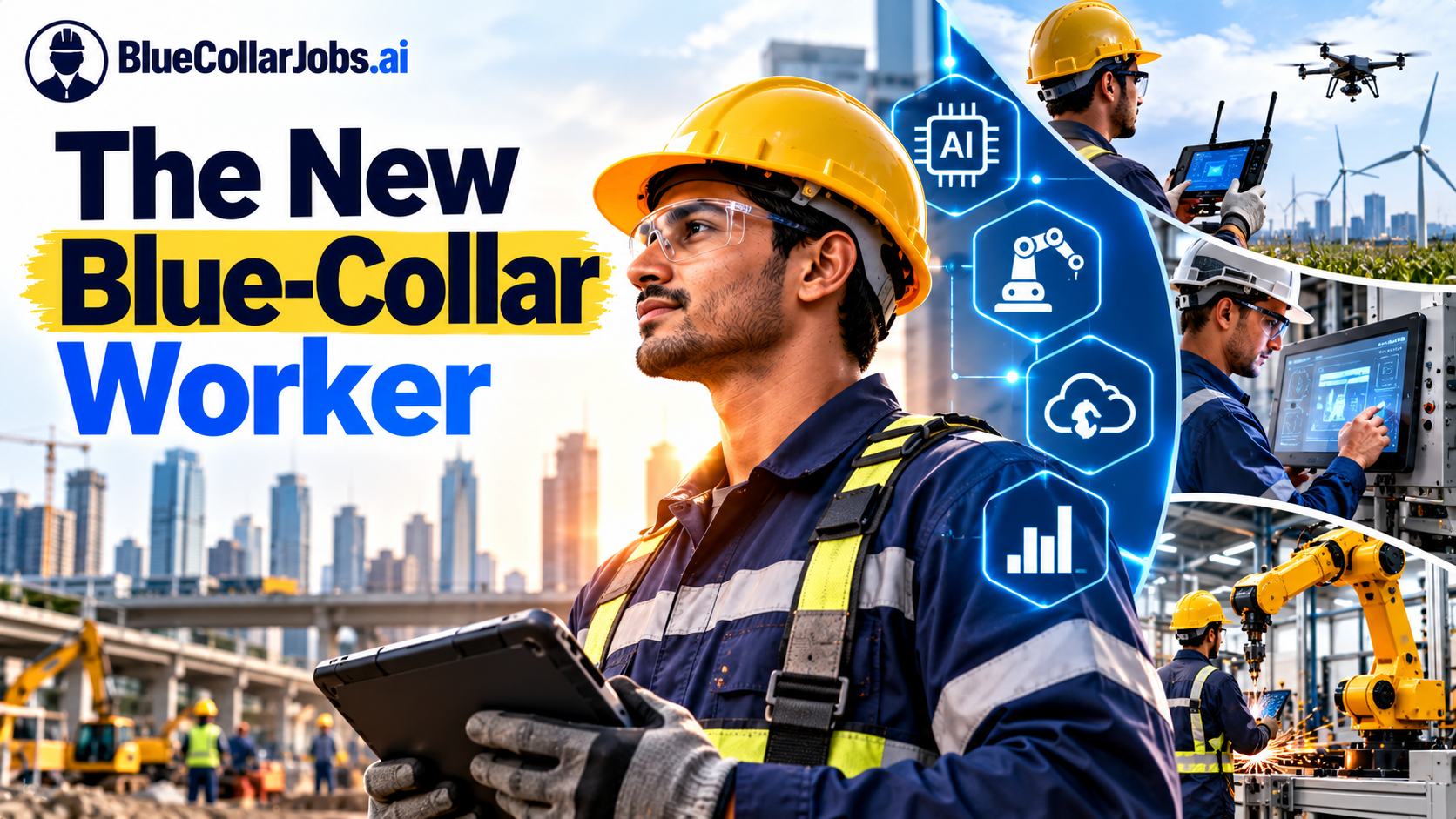
future of blue-collar jobs
The future warehouse operator will not pick boxes. They will supervise an entire robotic picking system, use augmented reality to identify system errors, and manage the exceptions that the algorithm cannot handle. The future electrician will carry a diagnostic tablet alongside their tools, run AI-assisted fault analysis, and interpret the data before making a decision that no AI can make for them.
Jobber's Annual Blue-Collar Report 2026 found that 73% of blue-collar workers already see AI as a positive force in their industry — not a threat. Workers who receive training in AI-adjacent tools are 50% more likely to be engaged in their work. The trades are not resisting technology. They are absorbing it.
And 76% of Gen Z respondents in the same report say it is important to choose a career that is difficult to automate. That preference is quietly reshaping where young people choose to invest their time — and the trades are benefiting.
Three Skills That Will Define Trades Workers Through 2030
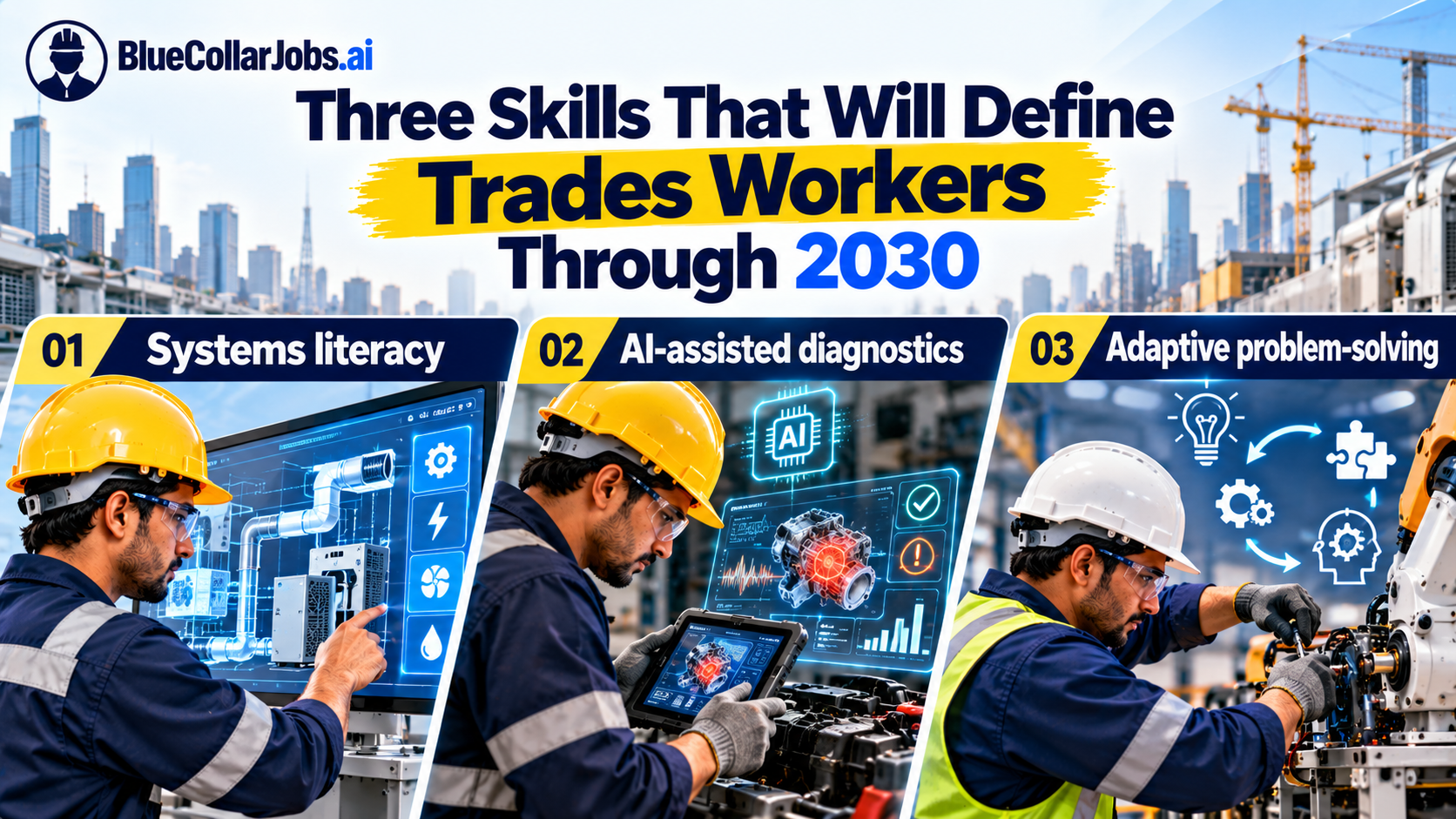
The blue-collar jobs that remain most secure over the next decade are those where workers combine traditional trade expertise with at least one of three new competencies:
Systems literacy. Understanding how robotic and automated systems operate — enough to manage them, interpret their outputs, and intervene when they fail. This does not require a computer science degree. It requires training and exposure.
AI-assisted diagnostics. Using software tools, sensor data, and predictive maintenance platforms to identify problems before they become failures. HVAC technicians, industrial electricians, and mechanical engineers are already doing this. The skill is increasingly table stakes.
Adaptive problem-solving. The work that is hardest to automate is work that changes. Plumbing in a 70-year-old building. Electrical faulting in a non-standard commercial fit-out. Emergency repairs on custom machinery. These require a combination of physical presence, professional judgment, and experience that no current system can replicate at commercial scale.
Where This Leaves the Trades
The future of blue-collar jobs is not simple. Some roles will contract. New ones are already being created faster than they are being filled. The skills required are shifting upward — and the workers who adapt will find themselves in one of the most secure and well-compensated positions in the entire labour market.
HVAC technicians are projected to see 15% job growth through the decade — more than double the national average. The elevator installer — long considered the definitive blue-collar job — now earns over $99,000 in the US. Australia's electrical lineworkers are approaching AU$145,000. These are not the salaries of a sector in decline.
The technology is changing the trades. The trades are not going away. The workers who understand both sides of that statement will be the ones who thrive in what comes next.
Frequently Asked Questions
1. Will AI replace blue-collar jobs by 2030?
Not broadly. The World Economic Forum's 2025 Future of Jobs Report classifies skilled trades as having "Very Low" automation disruption risk, with a net job growth of +10% to +20% projected through 2030. Repetitive manufacturing tasks face more exposure, but skilled, adaptive, physical trades — electrical work, plumbing, HVAC, maintenance — are projected to grow in demand, not contract.
2. Which blue-collar jobs are most at risk from automation?
The highest-risk blue-collar jobs are those built around single, repetitive, highly predictable tasks — assembly line packaging, basic machine feeding, standardised quality checking in controlled factory environments. Jobs that require adaptive physical problem-solving, professional judgment, and varied real-world environments carry significantly lower automation risk.
3. How is AI actually changing the trades in 2026?
AI is augmenting trades rather than replacing them. Trade workers are increasingly using AI-assisted diagnostic tools, predictive maintenance software, and augmented reality systems to improve precision and speed. Ford's newer manufacturing facilities already have skilled-trades workers maintaining robotic casting systems and configuring digital manufacturing processes — roles that did not exist a decade ago.
4. Should young people still consider blue-collar careers given AI?
The data says yes — strongly. Jobber's 2026 Annual Blue-Collar Report found that 68% of parents of Gen Alpha have reconsidered the long-term stability of white-collar careers because of AI, while 38% of Gen Z respondents say AI tools make trade careers more appealing. HVAC, electrical, and construction roles are among the fastest-growing, highest-paying, and least automatable careers in the current labour market.
5. What skills do blue-collar workers need to remain competitive as AI expands?
Three skills matter most: systems literacy (understanding and managing automated and robotic equipment), AI-assisted diagnostics (using sensor data and predictive maintenance tools), and adaptive problem-solving (handling non-standard, variable real-world situations). Workers who add these to their existing trade expertise will be among the most sought-after professionals in the global labour market through 2030 and beyond.
Sources: