
Blue-Collar Worker Salaries Around the World: Country-by-Country Comparison (2026)

Blue-Collar Worker Salaries
The global conversation about blue collar jobs has changed completely. What was once considered a secondary career path has become one of the most financially competitive sectors in the world. In 2026, a skilled electrician in Australia earns more than most university graduates. A welder in the UAE takes home tax-free pay that outpaces the average white-collar salary in India. Understanding blue-collar worker salaries across countries is no longer a niche interest; it is a strategic career decision that can change a worker's financial life. BlueCollarJobs.ai connects skilled workers across these markets directly to verified employers, with full transparency on pay and conditions.
The Global Picture: What the Data Shows
Before the country comparison, one number sets the context. The average blue collar worker salary in the United States in 2026 stands at $53,440 per year ($25.69 per hour), according to ZipRecruiter's September 2026 data, and that is just the average. The top 10% of skilled trade workers in the US earn over $100,000 annually. The US Bureau of Labour Statistics confirms that electricians now earn a median of $61,590 per year, while plumbers sit at $61,550, both exceeding the average starting salary for a bachelor's degree holder ($59,384).
This is the reality of blue collar jobs in 2026: skilled workers who once earned modestly are now competing with, and often beating, white-collar professionals at the pay scale.
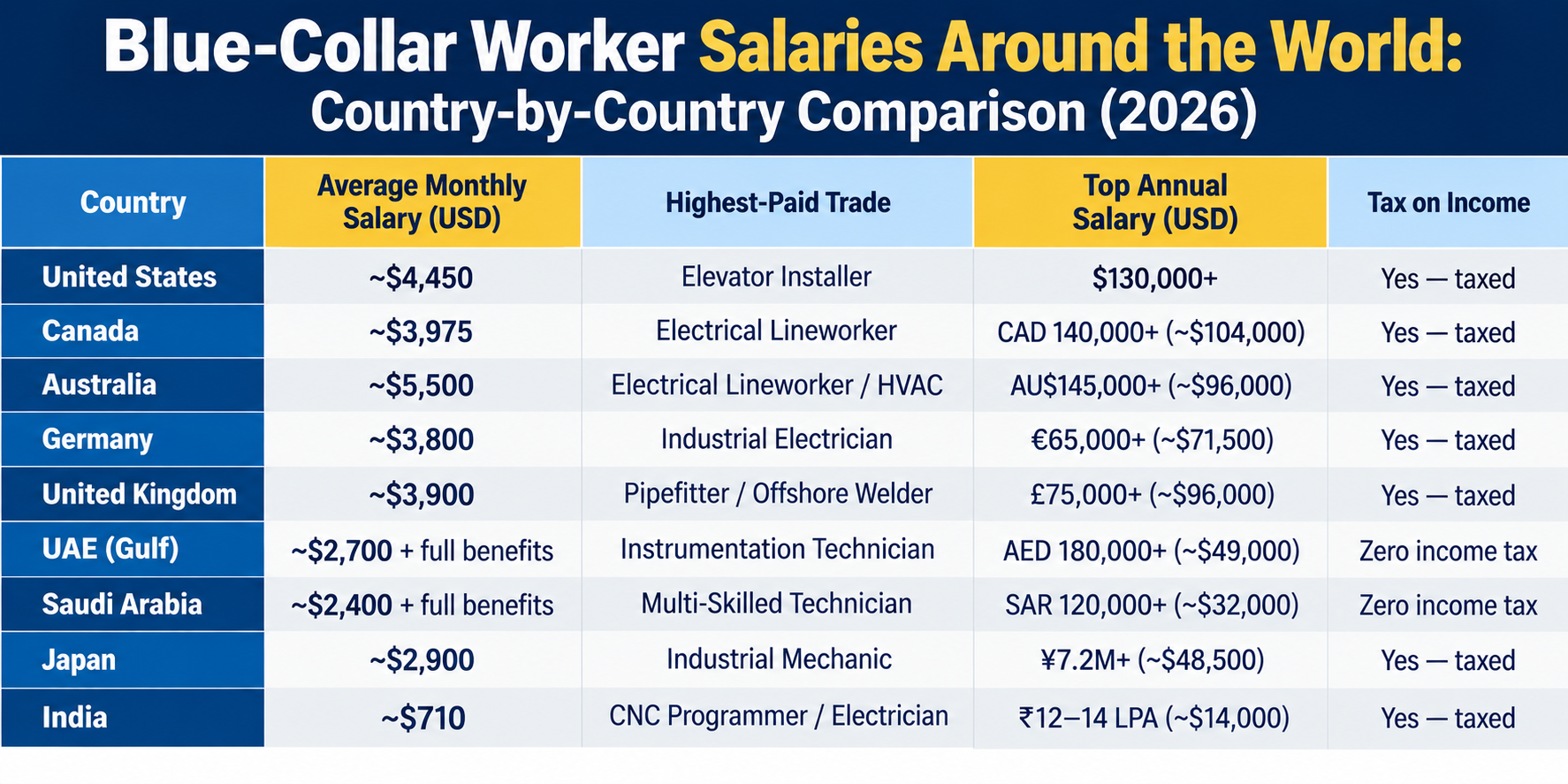
Country-by-Country Salary Comparison (2026)
Blue-Collar Worker Salaries
Benefits in Gulf countries (UAE/Saudi Arabia) typically include free housing, food allowances, medical insurance, and annual flights — which significantly increases the effective value of compensation.
Blue-Collar Worker Salaries: The Insight Behind the Numbers
Three patterns stand out when you read this data carefully.
The Gulf's effective pay is higher than it looks. While the headline salary in the UAE or Saudi Arabia appears lower than Australia or Germany in raw USD terms, the total compensation package - tax-free income, free housing, food, and medical care - means a worker keeps almost everything they earn. A Gulf salary of AED 2,500/month with full benefits can be worth more in real take-home than a UK salary of £3,500/month after tax and housing costs.
Australia and Canada are the highest in absolute terms. For the highest-paid blue collar jobs globally, English-speaking countries with strong trade unions and infrastructure booms pay the most. Australia's electrical lineworkers and Canadian elevator technicians consistently top the global comparison at AU$145,000 and CAD 140,000+, respectively.
India's gap with the world is closing - but slowly. The average blue collar worker salary in India is growing at 5 to 6% annually (Deloitte, 2025), and skilled roles like CNC programmers and HVAC specialists are approaching ₹10–14 LPA in metropolitan markets. But the real leverage for Indian workers remains international placement, where a single overseas contract can multiply income by three to five times.
What Determines Blue Collar Worker Salary Anywhere in the World?
Across every country in this comparison, four factors determine where a worker sits on the pay scale:

Certification and trade qualification. Electricians with NCVT credentials in India, CSWIP-certified welders in the Gulf, or licensed journeymen in the US consistently out-earn uncertified peers by 20 to 40%.
Specialisation. Pipeline welders, industrial electricians, underwater welders, and elevator technicians sit at the top of every country's salary range. Rare skills command rare pay, everywhere.
Location within country. New York-based construction workers earn $33.19/hour vs. $22.84 nationally. Gulf workers in Abu Dhabi often earn more than those in smaller Emirates. Germany's Munich-based tradespeople out-earn eastern Germany counterparts by 15 to 20%.
Experience and tenure. In the US, an electrician progresses from apprentice ($36,000–$65,000) to journeyman ($68,000–$100,000) to master electrician ($85,000–$125,000) in a structured pathway. Most countries follow a similar progression curve.
How BlueCollarJobs.ai Connects Workers to the Right Market
For Indian workers and skilled professionals globally, knowing the salary comparison is the first step. Accessing the right employer in the right country safely, directly, and without exploitation is where most workers face the biggest obstacle.

blue collar worker salaries
BlueCollarJobs.ai was built to bridge this gap. The platform lists verified blue collar jobs with screened employers across the Gulf, Germany, Australia, Canada, and domestically in India, with accurate salary data, a transparent process, and no middlemen. Whether you are comparing Gulf blue collar worker salaries against domestic options or looking for your first overseas placement, BlueCollarJobs.ai gives you the direct access you need.
Indian workers — Register for just ₹1,000
International workers — Join for just $20
Visit bluecollarjobs.ai - Register today and find your highest-paying blue collar job.
Frequently Asked Questions
1. Which country pays blue collar workers the most in 2026?
In absolute salary terms, Australia and Canada offer the highest blue collar worker salaries — with electrical lineworkers and elevator technicians earning AU$140,000–145,000 and CAD 135,000–140,000 respectively. In terms of take-home value after housing and living costs, Gulf countries (UAE and Saudi Arabia) are highly competitive due to zero income tax and full employer-provided benefits.
2. What is the average blue collar worker salary in the USA in 2026?
The average blue collar worker salary in the United States is $53,440 per year as of September 2026 (ZipRecruiter). Skilled tradespeople such as electricians ($61,590 median), plumbers ($61,550 median), and elevator installers ($99,000 median) earn significantly above the average. Top earners in specialised trades cross $100,000 annually.
3. How much do Indian blue collar workers earn compared to Gulf countries?
The average skilled blue collar worker salary in India ranges from ₹6–10 LPA (approximately $7,200–$12,000 per year) for certified electricians, welders, and HVAC technicians. The same worker in the UAE earns AED 2,000–3,500 per month ($6,550–$11,500 per year) — but with zero tax and free housing, food, and medical insurance included, the effective value is two to three times higher.
4. What blue collar jobs pay the most globally?
The highest-paying blue collar jobs across the world in 2026 are elevator installers/technicians (US $99,000–130,000+ median; Canada CAD 90,000–135,000+), electrical lineworkers (Australia AU$85,000–145,000), offshore and pipeline welders (UK £75,000+; underwater welders globally $100,000–$150,000+), and instrumentation technicians in the Gulf oil and gas sector.
5. Can Indian skilled workers get these international salaries through BlueCollarJobs.ai?
Yes. BlueCollarJobs.ai connects certified Indian tradespeople — electricians, welders, HVAC technicians, CNC operators, and construction workers — directly with verified employers offering blue collar jobs in the Gulf, Germany, Australia, and beyond. Indian workers register for ₹1,000 and gain direct access to international placements with accurate salary information, no agents, and no hidden fees.
Sources:
Bureau of Labor Statistics — Average Hourly Wages for Blue Collar Occupations 2026
The Birm Group — Why Skilled Trades Are Out-Earning College Graduates in 2026
Deloitte India — Blue Collar Workforce Trends and Wage Growth 2025
SkilledTradePath — Best Blue Collar Jobs in 2026: High Pay No Degree Required