
The Global Blue-Collar Labour Shortage: Which Countries Need Workers Most Right Now

Labour Shortage
The world is short of workers. Not in small pockets or isolated industries — but structurally, across continents, and in the skilled trades that keep economies moving. Korn Ferry estimates that by 2030, developed economies will face a shortage of 85 million workers, costing the global economy $8.5 trillion in unrealised annual revenues. The ILO's 2026 Employment and Social Trends report places the broader global jobs gap at 408 million — the number of people who want paid work but cannot access it.
The labour shortage is not a future risk. It is today's operating reality — and BlueCollarJobs.ai is directly addressing it by connecting skilled workers with verified employers across the countries hit hardest.
The Countries Facing the Most Severe Labour Shortage in 2026
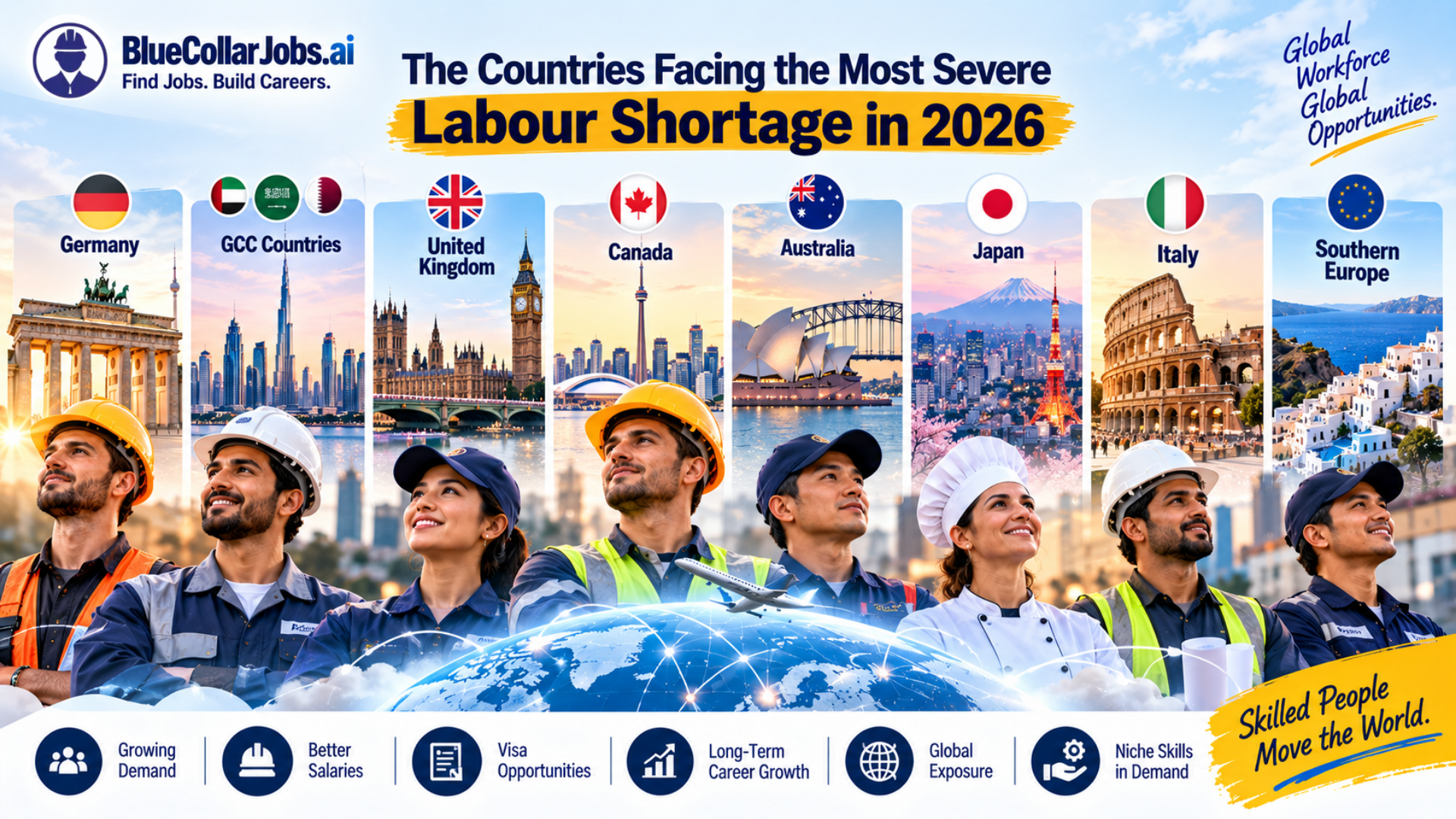
Labour Shortage
1. Germany — 600,000+ Vacancies
Germany's labour shortage is Europe's most acute. The Federal Employment Agency forecasts a need for 400,000 net immigration workers every year through 2030 to replace retiring workers and sustain industrial output. Construction alone accounts for 220,000+ open positions, with logistics drivers, automotive mechanics, and elderly care workers adding tens of thousands more. Germany's Skilled Immigration Act 4.0, enacted in January 2026, lowered the salary threshold for shortage occupations to €43,470 per year and expanded the Opportunity Card — making it the most accessible it has ever been for skilled foreign workers. Monthly salaries for blue-collar trades in Germany range from €2,500 to €4,100, with Indian workers now benefiting from a visa quota increase from 20,000 to 90,000 annually.
2. GCC Countries — 2.5 Million Workers Needed Over Three Years
The Gulf Cooperation Council faces a structural labour shortage driven by Vision 2030 megaprojects in Saudi Arabia, infrastructure expansion in the UAE, and continued industrial output requirements across Qatar, Kuwait, Oman, and Bahrain. An estimated 2.5 million skilled workers are required across the region over the next three years. Monthly salaries range from AED 2,000–3,500 in the UAE and SAR 2,200–3,500 in Saudi Arabia — all tax-free and typically with housing, food, and medical benefits included, making effective take-home significantly higher than base salary indicates.
3. United Kingdom — Record Visa Issuance
The UK issued more than 300,000 Skilled Worker visas in 2025 — a record high — with 2026 data showing no slowdown. The Shortage Occupation List was expanded again in January 2026, covering construction, healthcare, transport, and logistics. The current salary threshold stands at £41,700 per year. Despite political debates on migration, the UK remains one of the most actively open large economies for verified skilled workers right now.
4. Canada — 500,000 New Residents Per Year
Canada continues to absorb 500,000+ new permanent residents annually through 2027, with the Express Entry system and Provincial Nominee Programs covering a wide range of skilled trades — electricians, plumbers, welders, mechanics, and construction workers among the highest-priority categories. The labour shortage in healthcare, infrastructure, and logistics is particularly severe outside major urban centres, where trades workers are in acute demand.
5. Australia — Skills in Demand Visa
Australia launched the Skills in Demand (SID) visa in 2024 to replace its older temporary shortage pathway — a faster, more flexible system specifically designed to address a labour shortage affecting construction, aged care, and food production. The country's AUD 12.6 billion national skills investment is creating structured demand for skilled foreign workers. Experienced tradespeople — electricians, HVAC technicians, and construction specialists — earn between AU$79,000 and AU$145,000 annually.
6. Japan — 50,000 Indian Workers Planned
Japan's ageing population has created a deepening labour shortage in caregiving, manufacturing, logistics, and food services. The Specified Skilled Worker (SSW) visa programme has been expanded, and Japan has formally signalled plans to recruit 50,000 skilled Indian workers over five years. Wages rose 4.01% in 2026 — the third consecutive year of significant increases — and the country offers a clear long-term residency pathway for workers who commit.
7. Italy and Southern Europe — 500,000 Work Permits Approved
Italy's 2026 Flow Decree approved nearly 500,000 work permits for 2026–28, targeting construction, agriculture, and hospitality. Spain faces shortages in 78% of key sectors, and Greece has an estimated 250,000 unfilled positions even after expanding foreign worker quotas. Southern Europe's labour shortage is being driven by an ageing domestic workforce and a booming tourism and infrastructure sector that cannot be staffed locally.
India: The World's Preferred Answer to the Labour Shortage
India sits at the centre of the global workforce solution. The country has signed 28 migration and mobility agreements with 26 nations — including Germany, Italy, France, Japan, the UK, and Denmark — creating structured, legal pathways for Indian workers across every major shortage market. In FY25, India received $135.4 billion in remittances, the highest of any country in the world.

Labour Shortage
Russia alone issued 72,000 work permits to Indian workers in 2025, up from just 5,000 in 2021. Japan has formalised plans for 50,000 Indian workers. The India-EU Mobility Pact, signed in 2026, opens structured pathways across all 27 EU member states. The direction of Indian labour migration has expanded dramatically — workers are now heading to Warsaw, Tokyo, Rome, and Berlin, not only to Riyadh and Dubai.
How BlueCollarJobs.ai Is Connecting Indian Workers to Global Demand
Understanding which countries face the worst labour shortage is the starting point. Reaching those markets safely, with a verified employer, a real contract, and a transparent process, is where most workers encounter serious obstacles.

labour shortage
BlueCollarJobs.ai was built to remove those obstacles entirely. The platform connects skilled Indian workers across electrical, construction, welding, HVAC, logistics, CNC, and other trades directly with verified employers in Gulf countries, Germany, Australia, Canada, Japan, and beyond — with no middlemen, no fake listings, no hidden fees, and no confusion about what the offer entails.
Every employer on the platform is screened. Every opportunity is real. The global labour shortage is creating genuine demand for Indian skilled workers. BlueCollarJobs.ai ensures that demand reaches workers directly — not through agents who take cuts and promise what they cannot deliver.
Indian workers — Register for just ₹1,000
International workers — Join for just $20
Visit bluecollarjobs.ai — Register today and connect with the global employers who need your skills right now.
Frequently Asked Questions
1. Which country has the worst labour shortage in 2026?
Germany, Japan, and Canada consistently rank among the most severely affected economies. Germany has over 600,000 unfilled positions and requires 400,000 net immigration workers annually through 2030. Japan's ageing population has created a structural labour shortage across care, manufacturing, and logistics. Canada absorbs 500,000+ new workers per year and still cannot fully close its workforce gap.
2. Are Indian workers in demand globally in 2026?
Yes — significantly. India has signed 28 migration and mobility agreements with 26 countries in 2026. Japan plans to recruit 50,000 skilled Indian workers. Italy approved 500,000 work permits targeting nationalities that include Indian applicants. Germany raised the Indian worker visa quota to 90,000. The global labour shortage has made Indian skilled workers among the most actively sought workers internationally.
3. What trades are most in demand internationally due to the labour shortage?
Electricians, welders, HVAC technicians, construction workers, plumbers, heavy vehicle drivers, CNC machinists, elderly care workers, and healthcare support workers are among the most in-demand blue-collar roles across Germany, Australia, the UK, Canada, Japan, and Gulf countries. These roles are experiencing a labour shortage in virtually every developed economy simultaneously.
4. How can an Indian skilled worker find a verified international job?
Register on BlueCollarJobs.ai for ₹1,000. The platform lists verified job opportunities across all major labour shortage markets — Gulf countries, Germany, Australia, Canada, Japan, and more — with screened employers, accurate salary information, and a transparent process from application to placement. No agents. No hidden charges.
Sources:
Korn Ferry — Global Talent Crunch: 85 Million Worker Deficit by 2030
Visa Update — 5 Countries Desperately Seeking Thousands of Foreign Workers in 2026 (March 2026)
Jobbatical — Top 10 In-Demand Blue-Collar Jobs in Germany 2026
Careerical — Countries Begging for Workers in 2026 (February 2026)
Work Abroad — Top 15 Countries Hiring Indian Workers in 2026 (July 2026)
VisaWise Travel — Countries Actively Hiring Foreign Workers in 2026 (May 2026)