
The Complete Guide to Blue-Collar Jobs: Every Trade Explained
blue-collar jobs
If you are looking for a definitive, honest reference for blue-collar jobs — what they are, which trades exist, what they pay, and where the opportunities are — this is the guide. Every major trade is covered here. Every sector is explained. And whether you are a student exploring options, a professional thinking about a pivot, or an employer trying to understand this workforce, this page is built for you. BlueCollarJobs.ai connects workers across every one of these trades to verified, legitimate employers in India and worldwide.
Why Blue-Collar Jobs Are the Story of 2026
The numbers have shifted dramatically.
India's blue-collar job volumes surged 93% between early 2022 and early 2026, according to an analysis of over 50 million job postings by Randstad India. McKinsey forecasts that 70% of the 90 million new jobs India will create by 2030 will be blue-collar. Wages are growing at 5 to 6% annually — faster than most white-collar segments — with performance incentives now common across manufacturing, logistics, and construction.
Blue-collar workers make up over 80% of India's non-agricultural workforce. They are not a secondary part of the economy. They are the primary engine of it.
Every Major Blue-Collar Trade - Explained
blue-collar jobs
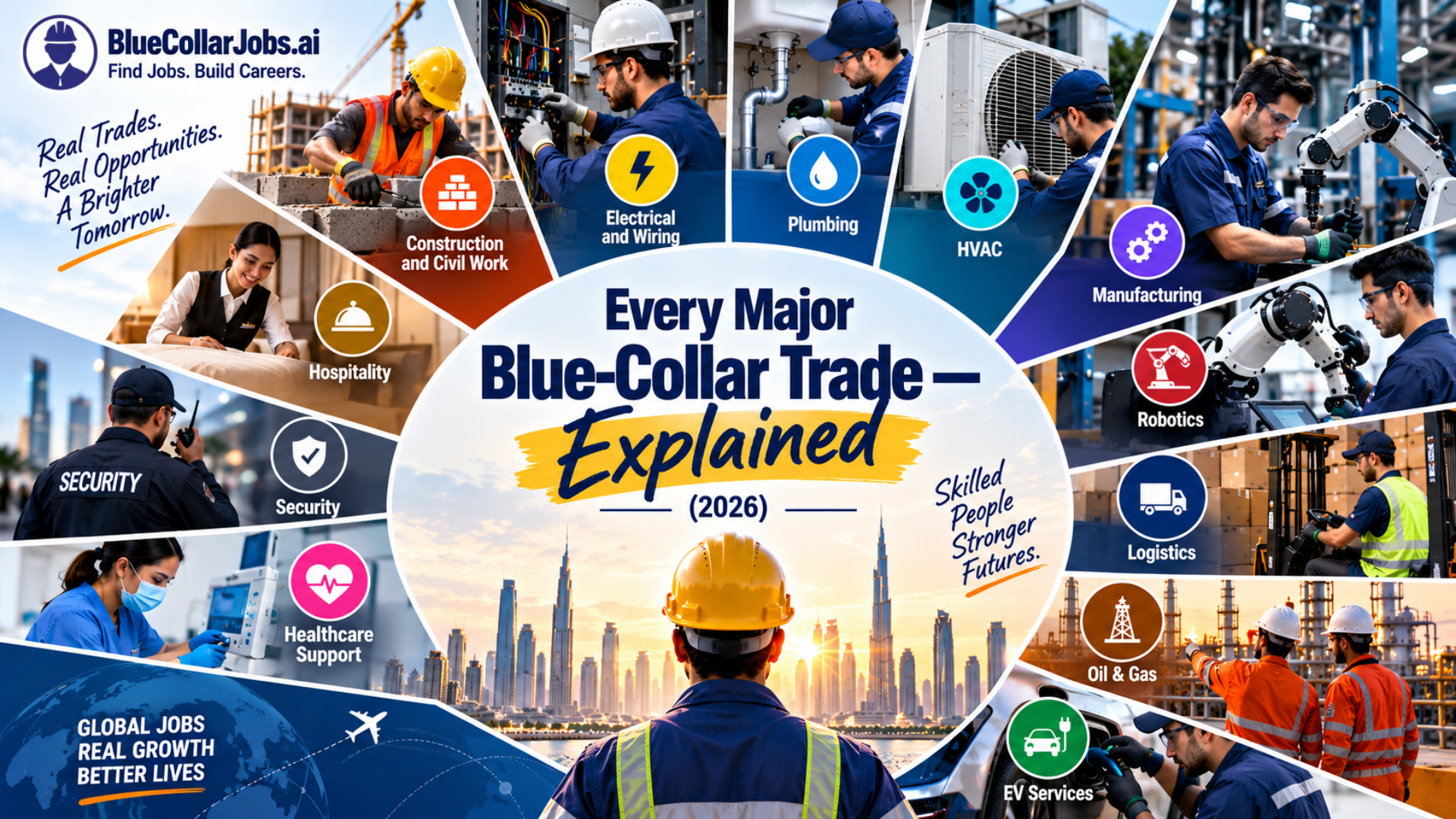
1. Construction and Civil Work
The backbone of India's infrastructure boom. Construction blue-collar jobs include masons, carpenters, shuttering workers, steel fixers, and civil helpers. With ₹12.2 lakh crore in government infrastructure spending committed for 2026–27, demand for construction workers is at its highest level in India's history. Globally, construction blue-collar roles pay especially well in Gulf countries, Australia, and Germany.
2. Electrical and Wiring
Electricians, wiremen, and electrical fitters are among the most in-demand blue-collar jobs in India and abroad. Demand has jumped 242% in four years, driven by data centres, smart cities, EVs, and renewable energy projects. An experienced electrician in India earns ₹8–10 LPA. In the UAE, the same professional earns AED 2,500–3,000 per month with free housing.
3. Plumbing and Pipefitting
Plumbers and pipefitters maintain water systems, drainage, and industrial pipelines. Specialised pipefitters working in aerospace, oil and gas, or high-pressure systems are classified as gold-collar blue-collar workers — among the highest-earning trade professionals in the world.
4. HVAC and Refrigeration
Heating, ventilation, and air conditioning technicians maintain climate control systems in factories, data centres, hospitals, and commercial buildings. Gulf countries face a critical shortage of HVAC specialists — making this one of the fastest pathways to a well-paid international blue-collar job from India.
5. Manufacturing and Production
Factory workers, machine operators, CNC programmers, quality technicians, and production supervisors all fall under manufacturing blue-collar jobs. Electronics manufacturing alone is projected to add 5 to 6 million jobs in India by 2026. Wages in this sector are growing at 9 to 9.1% per year.
6. Robotics and Automation Technicians
One of the newest categories in blue-collar work. These technicians install, maintain, and repair robotic systems on automated production lines. As smart factories expand across India and globally, robotics technicians are one of the fastest-growing and hardest-to-fill blue-collar roles in the market.
7. Logistics, Transport and Warehousing
Drivers (heavy and light vehicle), forklift operators, warehouse packers, inventory controllers, and delivery riders. The quick commerce boom has created entirely new blue-collar job categories that did not exist five years ago. India's logistics sector is adding hundreds of thousands of workers annually.
8. Oil, Gas and Renewable Energy
Instrumentation technicians, pipeline operators, rig workers, wind turbine technicians, and solar panel installers. Wind turbine technicians are the fastest-growing trade in the world at 45% projected growth. Solar installer demand is rising at 22%. Both are blue-collar jobs with strong global demand and excellent earning potential.
9. Automotive and EV Services
Mechanics, panel beaters, auto electricians, and the fast-growing category of EV battery technicians. Every electric vehicle sold creates demand for a technician who understands high-voltage battery systems — a skill set that is critically short across India and globally.
10. Healthcare Support
Hospital ward aides, lab assistants, medical equipment technicians, dental assistants, and paramedics are all blue-collar healthcare roles. Gulf countries report over 46,000 healthcare vacancies — with Indian workers among the most preferred candidates.
11. Hospitality and Food Services
Cooks, kitchen staff, hotel housekeeping, banquet workers, and food production workers. Hospitality blue-collar hiring in India grew 15% year-on-year in January 2026 according to Naukri JobSpeak — one of the fastest-growing segments in the entire jobs market.
12. Facility Management and Security
Security guards, CCTV operators, facility cleaners, and building maintenance workers. As India's urban real estate and commercial building stock expands, facility management has become one of the highest-volume blue-collar employment categories in the country, now regulated under formal frameworks like PSARA.
What Every Blue-Collar Trade Has in Common
Across every category above, three things hold true in 2026:
Skills are the currency. Certified, trained workers consistently earn more than uncertified peers — often by 20 to 40%. A trade certificate, ITI qualification, or Gulf-specific safety certification directly improves the salary a worker can command.
The shortage is real. Infrastructure job postings in India rose 62% between 2022 and 2023, while worker interest grew only 5%. The gap between supply and demand across blue-collar jobs is what makes this the best hiring market skilled workers have seen in a generation.
Global demand is expanding. Germany raised its skilled worker visa quota for Indians from 20,000 to 90,000. Australia has committed AUD 12.6 billion to trade training. Gulf countries need 2.5 million skilled workers over three years. Blue-collar expertise built in India is wanted across the world.
BlueCollarJobs.ai — The Hub for Every Blue-Collar Trade
BlueCollarJobs.ai is India's dedicated platform for workers across every trade listed in this guide — and the verified employers who need them.
Whether you are an electrician looking for a job in Dubai, a welder ready to move to Germany, a logistics driver seeking a verified employer in Pune, or an HVAC technician exploring Gulf opportunities, the platform gives you direct, transparent access to real employers with no middlemen, no fake listings, and no hidden charges.

blue-collar jobs
Every blue-collar job on BlueCollarJobs.ai is attached to a verified employer. Every salary is accurate. Every step of the process is visible before you commit.
Indian workers — Register for just ₹1,000 and access verified domestic and international placements
International workers — Join for just $20 and connect directly with employers across major hiring markets
This guide covers every trade. BlueCollarJobs.ai connects you to the opportunities within them.
Visit bluecollarjobs.ai — Register today and find your verified blue-collar job opportunity.
Frequently Asked Questions
1. What exactly is a blue-collar job?
A blue-collar job is any role primarily involving skilled or semi-skilled physical, technical, or trade-based work. This includes construction, manufacturing, electrical, plumbing, logistics, automotive, energy, hospitality, and facility management. The term covers an enormous range of careers — from entry-level helpers to gold-collar specialists earning over ₹10 LPA.
2. Are blue-collar jobs well paid in 2026?
Yes — and wages are improving consistently. Blue-collar wages in India are growing at 5 to 6% per year (Deloitte, 2025). Skilled roles such as electricians, HVAC technicians, and CNC programmers earn ₹6–12 LPA in India. The same roles in Gulf countries command AED 2,000–3,500 per month plus free housing, food, and medical insurance — making effective take-home two to three times higher than equivalent Indian roles.
3. Which blue-collar trade has the strongest future through 2030?
Electricians, renewable energy technicians, robotics specialists, HVAC workers, and EV mechanics are among the fastest-growing blue-collar jobs globally. Wind turbine technicians are the fastest-growing trade in the world at a projected 45% growth rate. All are accessible with the right ITI or recognised trade certification.
4. How can an Indian worker secure a blue-collar job abroad?
The requirements are a valid trade certificate (ITI or NCVT), current documentation, and a verified employer offer. The most direct and transparent route is registering on BlueCollarJobs.ai; the platform connects certified Indian workers with screened international employers across the Gulf, Germany, Australia, and beyond for just ₹1,000.
5. What is the difference between blue-collar, grey-collar, and gold-collar jobs?
Blue-collar covers skilled and semi-skilled trade work. ‘Grey-collar’ refers to roles that blend manual and administrative responsibilities — security personnel, healthcare aides, and hospitality supervisors. ‘Gold-collar’ describes elite technical specialists within blue-collar industries — CNC programmers, robotics technicians, and aircraft maintenance engineers — whose rare expertise commands premium compensation that rivals white-collar professional salaries.
Sources:
Economic Times / Hindupost — Blue-Collar Jobs Outpace White-Collar Growth (July 2026)
McKinsey / BW People — Blue-Collar Jobs to Drive 70% of India's New Job Growth by 2030
Deloitte India — Blue-Collar Wages Rise 5–6% Annually (May 2025)
V3 Staffing — Blue-Collar Jobs in India: Definition, Opportunities, and Career Pathways (March 2026)
Leap10x — Blue-Collar Jobs in India 2026: Where the Work Is Growing (July 2026)
Naukri JobSpeak — White-Collar Hiring Opens 2026 with 3% YoY Growth (February 2026)