
How Artificial Intelligence Is Changing the Way Skilled Workers Get Hired
Artificial Intelligence Hire
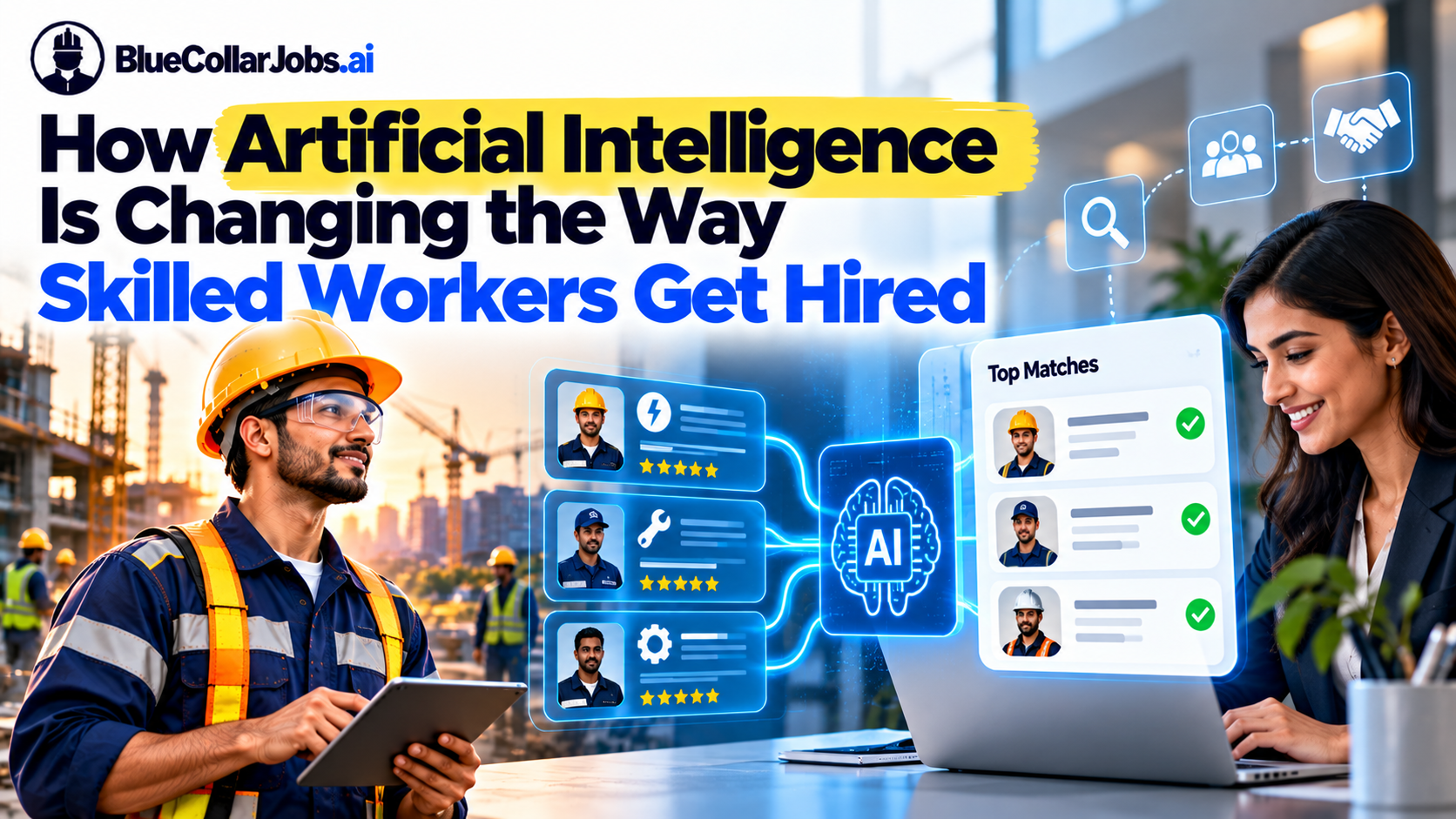
BlueCollarJobs.ai is one of the platforms at the front of this change - connecting skilled tradespeople with verified employers based on what they can do, where they are, and when they are available, rather than how well their CV reads. That model, once considered niche, is now where the entire hiring industry is heading.
To understand how and why AI is reshaping how companies hire skilled workers starts with understanding what the old system got wrong.
The Problem With CV-First Hiring for Skilled Workers
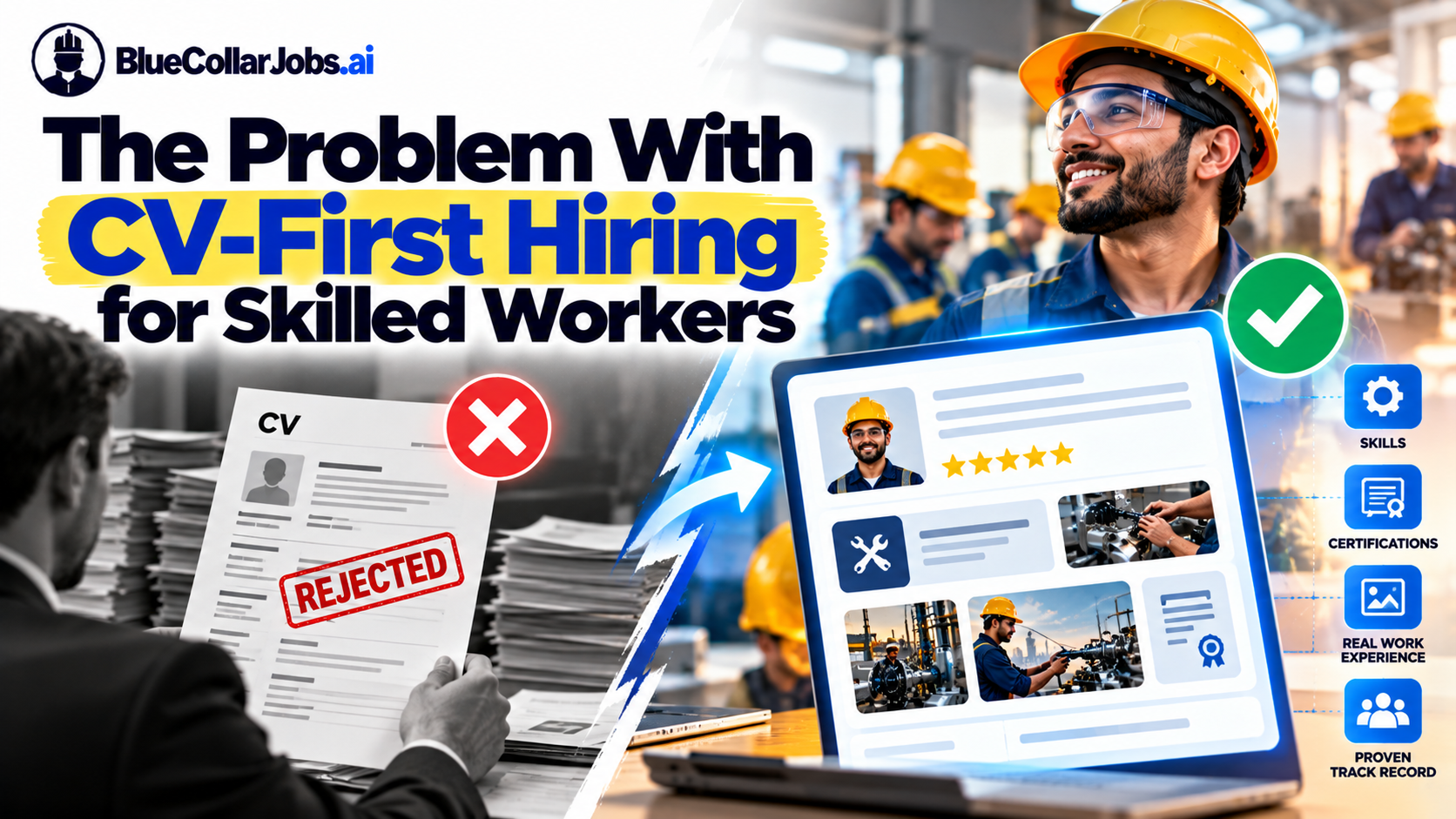
Traditional CV-based hiring often fails to capture the practical expertise of skilled workers. Plumbers, welders, and HVAC technicians demonstrate their value through hands-on experience, certifications, and job-site performance rather than written resumes. This creates a talent-matching gap in India, where the demand for skilled workers continues to grow.
Artificial Intelligence Hire
Key Information | Details |
|---|---|
Skilled Worker Shortage | Approximately 150 million skilled workers, according to the cited 2024 industry analysis. |
Blue-Collar and Grey-Collar Workforce | Over 300 million people work in these roles in India. |
Formal Skill Training |
|
Limitations of CV-First Hiring | Keyword filters, degree requirements, and resume screening can overlook practical skills and trade expertise. |
Core Problem | A mismatch between workers' actual capabilities and traditional recruitment methods. |
Role of AI | AI-powered hiring can help match workers with suitable jobs based on skills, certifications, experience, and job requirements. |
Key takeaway: India’s skilled-worker challenge is not simply a shortage of talent; it is also a problem of identifying and matching qualified workers with the right opportunities. AI-driven recruitment offers a way to make hiring more skills-focused, efficient, and accessible.
Editorial note: Verify the statistics against their original sources before publishing, particularly the 150 million worker shortage and 5% formal training figures.
How AI Matches on Skill, Location, and Availability Instead of CVs
AI-powered hiring systems approach the question of how to hire skilled workers through three variables that the CV-first model consistently ignored:
1. Skill: AI can read a worker's trade certification, practical test result, or employer-verified record and match it to what a job actually requires, without relying on the worker to describe their abilities in writing.
2. Location: For skilled work, physical proximity to the job site is non-negotiable. AI hiring tools factor in distance, travel time, relocation willingness, and contract duration in ways that a static job board cannot.
3. Availability: A worker available on Monday is not the same as a worker available in six weeks. AI matching accounts for current commitments, notice periods, and seasonal availability, making the hire to join timeline realistic from day one.
This shift is measurable. As of 2026, 58 to 65% of large Indian enterprises have deployed AI in at least one stage of their hiring process, up from just 34% in 2023, according to NASSCOM's HR Tech Landscape Report 2025–26. For blue-collar and frontline roles specifically, AI phone screening achieves candidate completion rates of 74 to 82%, compared to just 28 to 35% for traditional email-based approaches (Deloitte India HR Technology Survey, 2026).
The efficiency gain is clear. But the deeper shift is structural: 30% of Indian companies are now removing degree requirements entirely and replacing them with skills-first criteria, already ahead of the global average of 19% (NeoIntelli, 2026).
From Hire-to-Fill to Hire-to-Join: The Real Shift
The traditional system is optimised for speed: get someone into the role, move on. The outcome was high churn. Blue-collar roles in India see monthly attrition rates of over 15%, according to multiple industry analyses. Workers placed badly leave quickly. Employers absorb the replacement cost and repeat the process.
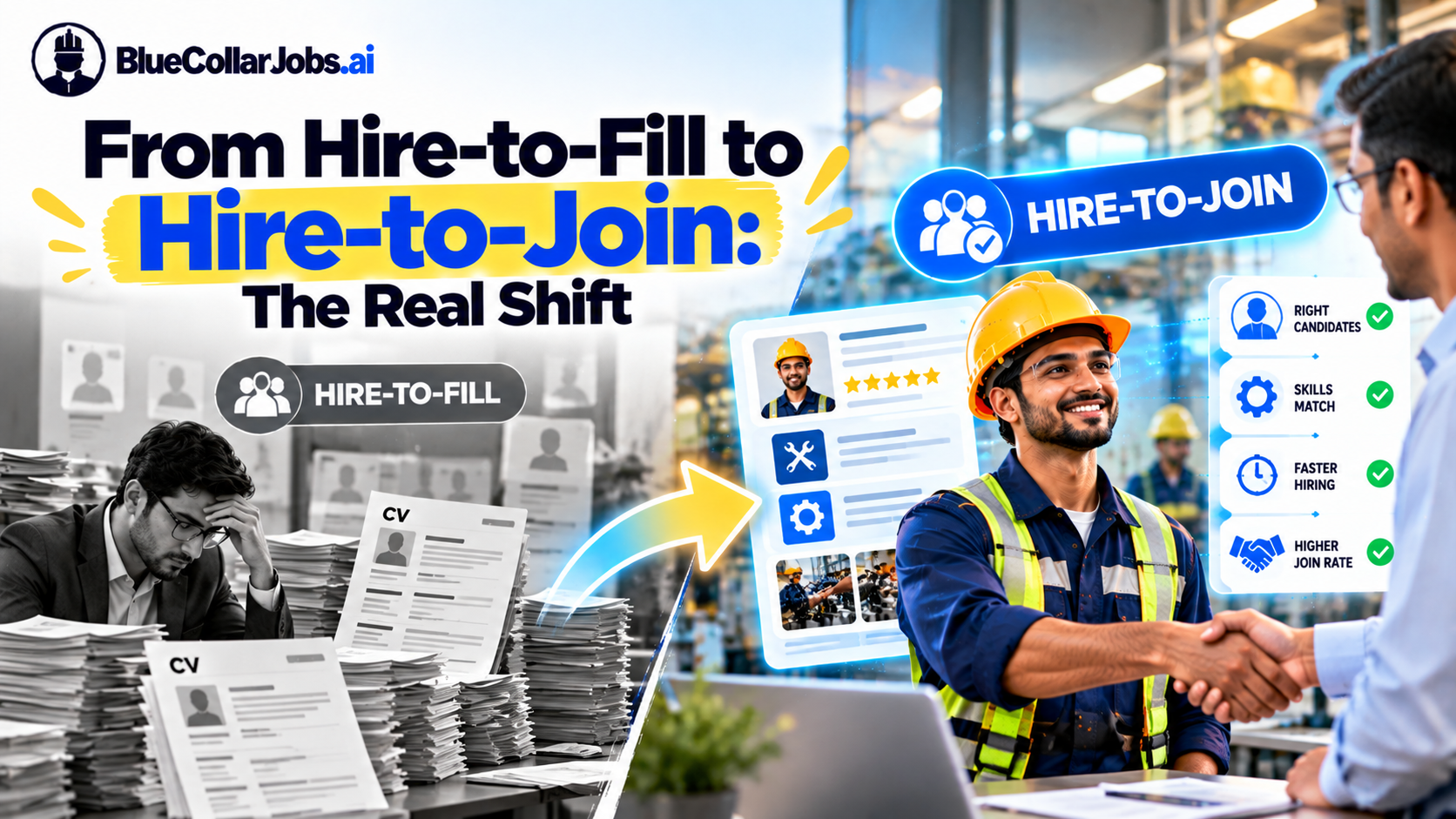
AI-driven matching enables a different outcome: hire to join. The worker placed through skill, location, and availability matching stays longer because the match was real — not an approximation built from keyword filters.
Platforms like BlueCollarJobs.ai operationalise this model for the Indian blue-collar market. Rather than asking a tradesperson to compete with a formatted document, the platform takes their certification, trade category, location, and availability — and connects them directly with verified employers in India, the Gulf, Germany, Australia, and beyond. Every employer on the platform is screened. Every hire to join the pathway is transparent from application to placement. Workers register for just ₹1,000 (Indian workers) or $20 (international workers) and access opportunities that match their actual capability.
This is not a minor upgrade to the old way of doing things. It is a different approach to what hiring is supposed to accomplish.
Frequently Asked Questions
1. What is the hire meaning in Hindi?
Hire meaning in Hindi is काम पर रखना (kaam par rakhna), meaning to put someone to work, or नियुक्त करना (niyukt karna), meaning to formally appoint someone to a role. In the context of skilled labour hiring, it refers to the formal process of matching a worker to a job based on their skills, location, and availability.
2. What does "hire to join" mean in recruitment?
Hire to join means hiring a worker with the intent that they become a stable, long-term member of a team — not simply filling a vacancy as fast as possible. It emphasises matching on skill, location, culture, and availability. AI-driven platforms are making hire to join more achievable by replacing broad keyword filtering with precise, multi-variable matching that reduces mismatches and lowers attrition.
3. How is AI changing the way companies hire skilled workers in India?
As of 2026, 58 to 65% of large Indian enterprises use AI in at least one hiring stage (NASSCOM, 2026). For skilled and blue-collar roles, AI phone screening achieves completion rates of 74 to 82% versus 28 to 35% for email-based outreach (Deloitte India, 2026). AI matches workers on verified skills, location, and availability — rather than CV keywords — increasing placement quality and reducing churn.
4. Why does CV-based hiring fail for skilled workers?
CVs are designed for office careers. Skilled workers — electricians, welders, HVAC technicians and CNC operators, hold their value in certified trade ability, not written documents. Traditional keyword-filtering systems eliminate qualified candidates before a human ever reviews them. Only 5% of India's workforce has received formal skill training, yet the country faces a 150-million skilled worker shortage — a gap created largely by inefficient matching, not a lack of people.
5. How does BlueCollarJobs.ai use the AI hiring model to connect skilled workers with employers?
BlueCollarJobs.ai connects certified tradespeople with verified employers using skill, location, and availability as the core matching variables — not CV formatting. The platform serves the Indian blue-collar market domestically and internationally, with placements across India, Gulf countries, Germany, and Australia. Workers register for ₹1,000 (Indian) or $20 (international) and access verified job listings where the hire to join pathway is transparent at every stage.
Sources:
Taggd — Blue Collar Jobs in India: The 2026 CHRO Hiring Guide (June 2026)
Babblebots — AI Hiring in India 2026: Statistics, Adoption Rates & What's Actually Working
Karyvio — AI Is Changing Fresher Hiring in India in 2026 (October 2026)
Careers360 — India Skills Report 2026: Employability Reaches 56.35%
Matcha.ai — Skills-Based Hiring in 2026: What You Need to Know
Testlify — AI in Recruitment: The Complete 2026 Strategy Guide (September 2026)